
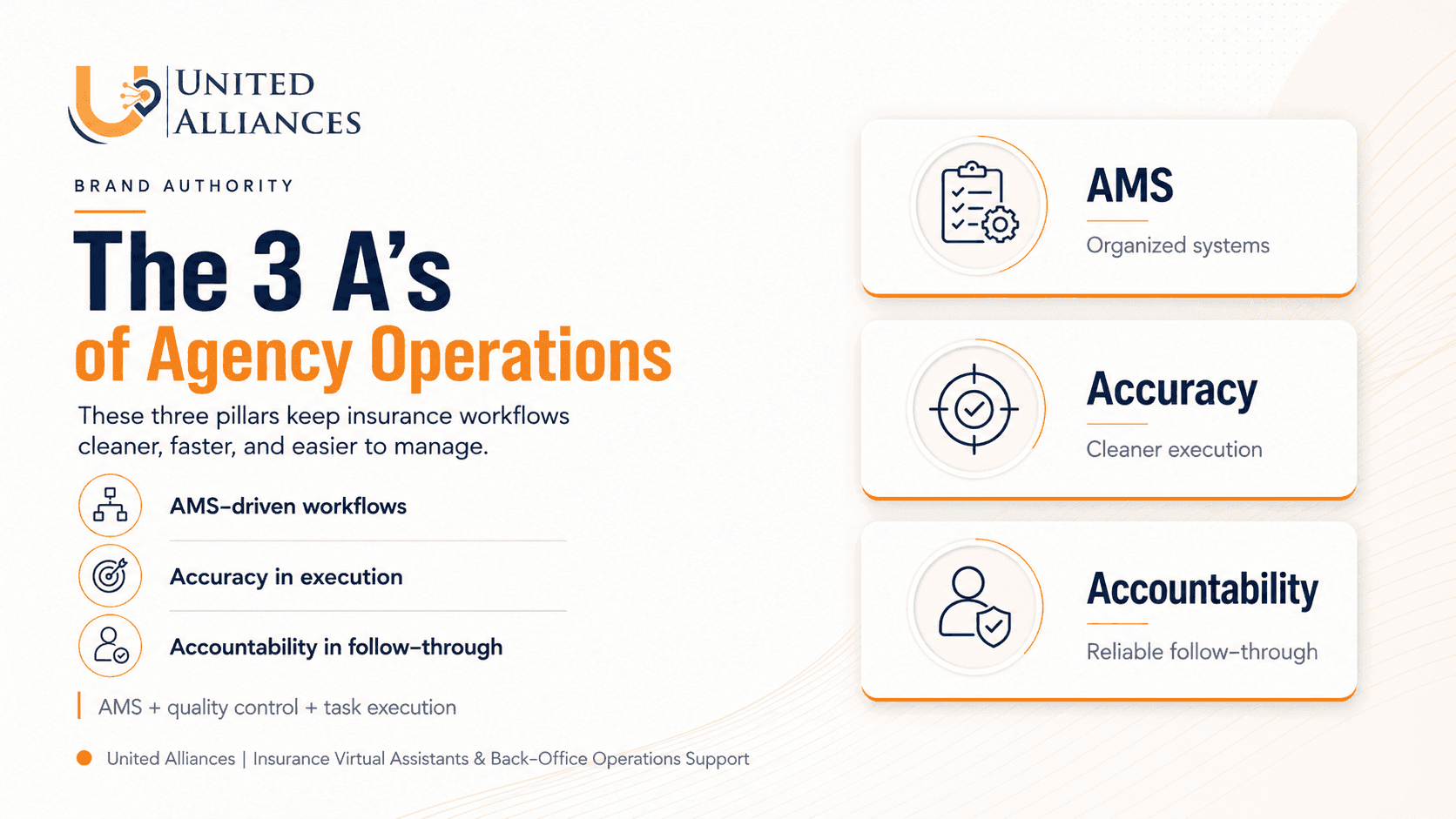

The Three A’s of Strong Insurance Agency Operations
Insurance agencies rarely struggle because their teams lack commitment. More often, the real challenge is operational pressure.
A growing number of policy requests, renewals, endorsements, certificates, carrier follow-ups, client emails, and system updates can quickly fill the workday. When these responsibilities are not supported by a clear operational structure, even experienced teams can feel stretched.
Strong agency operations are not built on effort alone. They are built on three practical pillars:
- AMS
- Accuracy
- Accountability
Together, these three A’s help insurance agencies create cleaner workflows, complete tasks more consistently, and maintain dependable follow-through.
1. AMS: The Foundation of Organized Operations
An Agency Management System, or AMS, is more than a place to store policy information. It is the operational centre of an insurance agency.
When an AMS is maintained properly, team members can quickly:
- Understand the current status of an account
- Review recent activity
- Find important documents
- Track open tasks
- Continue work without unnecessary delays
Problems begin when updates are postponed or entered inconsistently.
Missing notes, outdated contact information, incomplete activity records, incorrectly attached documents, and open tasks without clear ownership can create confusion across the agency. One employee may believe a request has been completed, while another is still waiting for confirmation.
A well-managed AMS provides structure.
Every endorsement request, renewal activity, certificate, follow-up, and client interaction should leave a clear record. That record allows producers, account managers, CSRs, and support teams to remain aligned.
The goal is not simply to enter data. The goal is to create an organised system that makes the agency easier to operate.
2. Accuracy: Getting the Details Right
Insurance operations depend heavily on details.
A small error in a certificate holder’s name, vehicle information, mortgagee address, coverage limit, policy number, or effective date can lead to additional emails, delays, and client frustration.
That is why accuracy must be treated as part of the workflow, not as a final check performed only when something goes wrong.
A reliable process should include:
- Clear instructions
- Updated account information
- Standardised documentation practices
- Quality-control checkpoints
- A final review before completion
Before a task is marked complete, the team should confirm that the information matches the original request and that all supporting documents have been saved correctly.
Accuracy also improves when work is assigned to people who understand insurance processes. Someone familiar with AMS platforms, carrier portals, ACORD forms, policy documents, and common servicing requests is more likely to recognise missing information before it becomes a larger problem.
Cleaner execution reduces rework. It also allows the internal team to spend less time correcting avoidable mistakes and more time supporting clients, renewals, and revenue-producing activities.
3. Accountability: Reliable Follow-Through
A task is not complete simply because someone started it.
Many insurance workflows require several steps:
- A carrier may need to be contacted more than once.
- A client may need to provide additional information.
- A document may require approval before it can be released.
- A policy update may need to be confirmed in both the carrier portal and the AMS.
Without accountability, these tasks can remain open longer than expected.
Accountability means that every responsibility has:
- A clear owner
- An expected completion time
- A visible status
- A documented follow-up process
Team members should know what needs attention, what is waiting on another party, and what has been fully completed.
This does not require constant supervision. In fact, the best operational systems reduce the need for repeated reminders.
Clear task assignments, documented follow-ups, internal checklists, regular reporting, and escalation procedures create dependable follow-through. Managers gain better visibility, while employees understand exactly what is expected of them.
Clients may never see the internal process, but they notice the result:
- Faster responses
- Fewer missed requests
- More consistent service
How the Three A’s Work Together
AMS, accuracy, and accountability should not operate separately.
The AMS provides the structure. Accuracy protects the quality of the work. Accountability ensures that tasks continue moving until they are fully resolved.
For example, consider a client requesting an endorsement:
- The request is documented in the AMS.
- The policy details are reviewed carefully for accuracy.
- The task is assigned to a responsible team member.
- Any carrier follow-up is tracked.
- Once the endorsement is received, the document is reviewed.
- The document is saved and shared with the client.
- The activity is closed with a complete record.
That is what a clean insurance workflow looks like.
Building a More Reliable Agency Operation
Agency growth becomes difficult when every task depends on individual memory, scattered emails, or manual reminders.
A stronger approach is to build workflows around organised systems, careful execution, and visible ownership.
Insurance Virtual Assistants and back-office operations teams can support this structure by:
- Maintaining AMS records
- Processing routine service requests
- Tracking carrier and client follow-ups
- Organising policy documentation
- Providing regular task updates
- Helping teams maintain consistent workflows
When the three A’s are working together, agency operations become cleaner, faster, and easier to manage.