

A Better Way to Handle Insurance Back-Office Support
Most insurance agencies are not worried about finding opportunities.
They are worried about keeping up with the operational work that follows.
Policies accumulate. Renewals arrive faster than expected. Endorsement requests multiply. Certificates, audits, documentation, carrier follow-ups, and AMS updates never truly slow down.
Growth sounds exciting until the back office begins struggling under the weight of it.
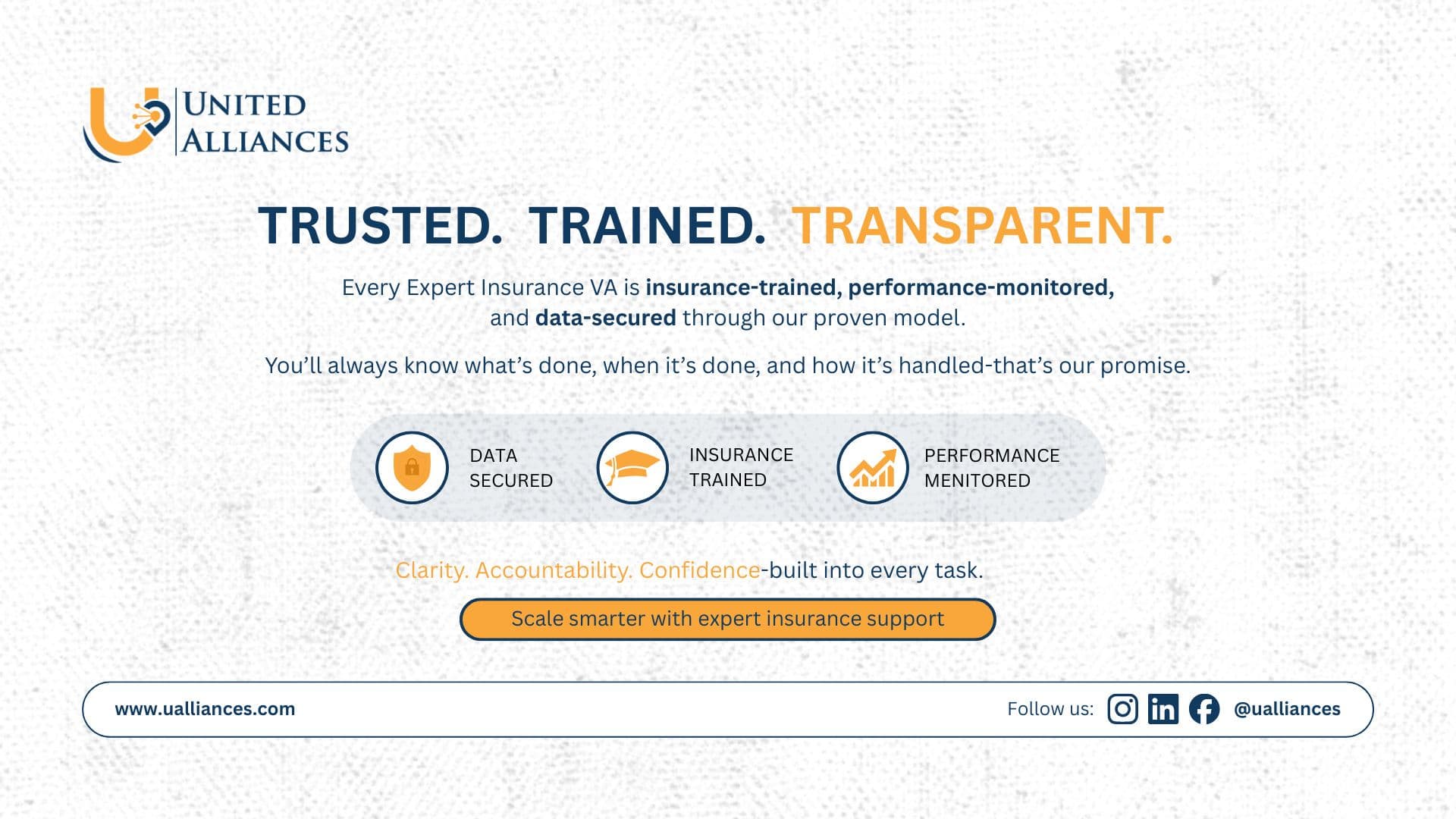
That is where the idea of being Trusted. Trained. Transparent. stops being a tagline and becomes a practical operational advantage—especially when an agency works with an Insurance Virtual Assistant.
Trusted: Because Insurance Runs on Confidence
Trust is not simply a marketing term in the insurance industry.
It is the foundation of every client relationship and every operational process.
Insurance agencies handle sensitive information every day, including:
- Client financial information
- Policy details
- Personal identification records
- Claims documentation
- Compliance information
- Carrier correspondence
If an operational support partner does not treat that information with the seriousness it deserves, nothing else truly matters.
A trusted back-office support structure should include:
- Secure handling of client information
- Controlled system permissions
- Clear confidentiality standards
- Documented security practices
- Repeatable operational workflows
- Defined accountability for every task
However, trust goes beyond cybersecurity and data protection.
It also appears through consistency.
Tasks are completed correctly. Deadlines are respected. Communication remains reliable. Problems are reported instead of hidden.
There are no unexplained delays, missing updates, or unexpected gaps in execution.
Many agency owners hesitate when they first consider outsourcing, and that concern is understandable. Handing part of the agency’s operational workload to an external support team can initially feel risky.
But when the structure is secure, documented, and dependable, outsourcing stops feeling like a gamble.
It begins to feel like smart operational leadership.
For a growing agency—or an outsourcing company seeking an insurance-focused support partner—reliability is not optional.
It is the baseline.
Trained: Insurance Is Not Generic Administrative Work
Insurance operations are not the same as general virtual assistant tasks.
An agency cannot simply assign complex policy servicing responsibilities to someone with basic administrative experience and expect consistent results.
Insurance has its own:
- Terminology
- Systems
- Documentation standards
- Carrier requirements
- Service timelines
- Compliance expectations
- Client communication processes
A properly trained Insurance Virtual Assistant should understand the workflow behind the task—not only the task itself.
This may include familiarity with:
- The complete policy lifecycle
- Endorsement processing
- Certificates of Insurance
- Renewal preparation and follow-ups
- Carrier communication
- Agency Management Systems
- CRM platforms
- Policy documentation
- Data accuracy requirements
- Routine servicing requests
That experience matters more than many agencies initially realize.
When an Insurance Virtual Assistant already understands renewal timelines, policy documentation, AMS updates, and common service requests, onboarding becomes more efficient.
Managers spend less time explaining basic processes. Producers are not repeatedly pulled into back-office corrections. Account managers gain more space to focus on clients.
Internal teams can then dedicate more attention to:
- Client retention
- Referral development
- Cross-selling
- Relationship management
- Marketing initiatives
- Agency growth
Specialization saves time.
And in insurance operations, saved time compounds quickly.
Transparent: No Guesswork and No Black Box
One of the greatest concerns agencies have about outsourcing is losing visibility.
They do not want important work disappearing into a process they cannot see or measure.
Transparency changes the entire outsourcing relationship.
Professional insurance back-office support should provide:
- Clear task tracking
- Defined turnaround times
- Visible ownership
- Measurable performance standards
- Regular status reporting
- Ongoing workflow visibility
- Clear escalation procedures
Agency leaders should know:
- What has been completed
- What is currently in progress
- What is waiting on the client
- What is waiting on the carrier
- Which tasks require immediate attention
- Which items are approaching their deadlines
They should not need to chase updates or repeatedly ask whether a task has been handled.
When reporting is structured and communication is consistent, accountability becomes a natural part of the workflow.
Managers can identify improvements. Bottlenecks become visible. Delays can be addressed before they grow into larger problems.
Transparency turns operational support into something measurable—and measurable systems can be improved.
Smarter Scaling Without Inflated Overhead
Scaling an insurance agency does not always require adding more in-house employees.
Traditional hiring can bring additional expenses, including:
- Salaries
- Payroll taxes
- Employee benefits
- Recruitment costs
- Office space
- Equipment
- Software access
- Training
- Management time
Fixed overhead can increase quickly, and once it has been added, it may be difficult to reverse.
Structured insurance back-office support offers another path.
With the right support model in place, agencies can:
- Reduce internal operational pressure
- Control overhead costs
- Improve turnaround times
- Maintain consistent service standards
- Increase back-office capacity
- Strengthen workflow efficiency
- Support growth without unnecessary complexity
The objective is not to replace the internal team.
It is to strengthen the operational foundation beneath them.
When routine administrative and servicing responsibilities are handled securely and professionally, internal employees can focus on higher-value activities such as:
- Building client relationships
- Improving retention
- Identifying coverage opportunities
- Supporting renewals
- Cross-selling
- Developing new business
- Planning long-term growth
That is where the agency’s experienced professionals provide the greatest value.
What Trusted Support Looks Like in Practice
Trust is created through daily execution.
It means the support team:
- Handles client information securely
- Follows documented procedures
- Communicates problems clearly
- Meets agreed turnaround times
- Maintains accurate records
- Protects the agency’s confidentiality
- Takes ownership of assigned responsibilities
Trust does not come from promises alone.
It is built through reliable performance over time.
What Trained Support Looks Like in Practice
Training means understanding how insurance work moves through the agency.
A trained Insurance Virtual Assistant should know that completing a task involves more than checking a box.
For example, processing an endorsement may require:
- Reviewing the client’s request
- Confirming that all required information is available
- Submitting the request through the correct carrier channel
- Tracking the pending update
- Reviewing the completed endorsement
- Saving the documentation correctly
- Updating the AMS
- Communicating the result to the appropriate person
That workflow awareness helps reduce errors, delays, and unnecessary rework.
What Transparent Support Looks Like in Practice
Transparency means that the agency always has visibility into its operational work.
A clear reporting structure may include:
- Completed tasks
- Pending items
- Overdue follow-ups
- Carrier dependencies
- Client dependencies
- Turnaround-time performance
- Escalated concerns
- Daily or weekly workflow summaries
This visibility gives managers greater confidence without requiring constant supervision.
They remain informed while allowing the support team to execute independently.
Why Trusted. Trained. Transparent. Still Matters
The insurance industry is not slowing down.
Client expectations are increasing. Compliance responsibilities remain demanding. Competition continues to grow. Agencies are expected to respond faster while maintaining accuracy and service quality.
Operational clarity is no longer a luxury.
It is a requirement for sustainable growth.
A back-office support system built on trust, insurance-specific training, and measurable transparency gives agencies room to grow without losing control.
- Trusted, because client information and agency processes must be protected
- Trained, because insurance operations require specialized knowledge
- Transparent, because agencies need complete visibility and accountability
That is more than administrative support.
It is operational stability—the kind that allows insurance agencies to scale confidently instead of constantly scrambling to keep up.