
Why Leaders Must Shift From Execution to Strategy
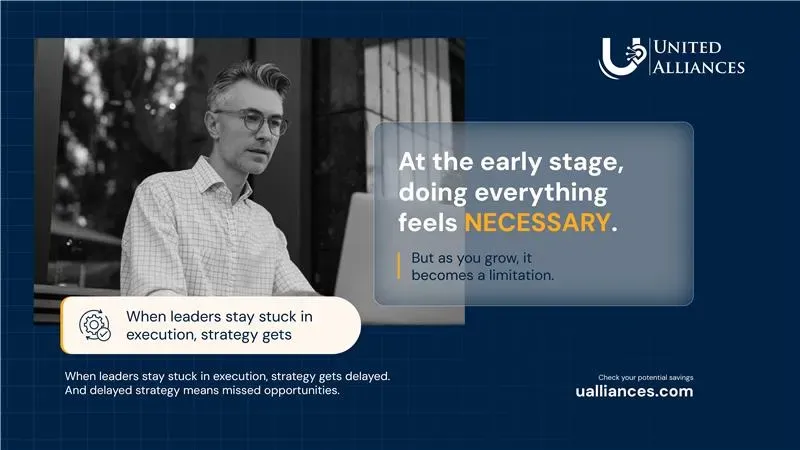
At the beginning of building a business, doing everything yourself does not just feel normal—it feels necessary.
You are involved in every email, every task, and every decision. You know exactly what is happening at every stage, and that creates a strong sense of control.
In the early days, this approach works.
It helps you:
- Understand your operations deeply
- Shape your standards
- Learn what clients expect
- Identify how work should be completed
- Build the foundation of the business
But there is something many business owners do not realize:
What helps you grow in the beginning can quietly start limiting you later.
The Shift No One Prepares You For
Growth does not come with a clear signal.
There is no moment when someone tells you:
“Now it is time to stop doing everything yourself.”
Instead, the transition happens gradually.
- Your workload increases
- Your responsibilities expand
- Your team becomes larger
- Your decisions carry more weight
- More people begin depending on your direction
But when your role does not evolve with the business, something starts to feel wrong.
You may still be working hard—possibly harder than before—but progress no longer feels as fast.
That is often because your role has not shifted from execution to leadership.
The Execution Trap
Execution feels productive.
You are:
- Replying to emails
- Managing tasks
- Solving problems
- Reviewing work
- Answering questions
- Keeping everything moving
This activity creates the satisfaction of being in control.
But there is a hidden cost.
Every hour spent on execution is an hour that cannot be spent on strategy.
Strategy is what helps a business identify opportunities, improve systems, strengthen teams, and prepare for the future.
When leaders remain stuck in execution, strategy does not disappear.
It simply gets delayed.
And delayed strategy creates a ripple effect across the entire business.
When Strategy Gets Delayed, Opportunities Do Not Wait
Delayed strategy does not always look like failure.
In fact, everything may appear fine on the surface.
- Work is being completed
- Clients are being served
- The team is active
- Revenue is still coming in
- Daily operations are continuing
But underneath that activity, something important may be happening.
You are:
- Reacting instead of planning
- Maintaining instead of improving
- Solving immediate problems instead of preventing them
- Moving constantly without necessarily moving forward
While you are busy managing today’s work, opportunities that require forward thinking can begin slipping away.
- New systems are not implemented
- Better processes are not explored
- Expansion plans are postponed
- Team development is delayed
- Growth decisions remain unfinished
- Important partnerships are not pursued
Over time, this creates a gap between:
- Where the business is today
- Where the business could be
Why Letting Go Feels So Difficult
The solution may appear obvious: delegate more.
But delegation is not always easy.
Letting go of execution can feel uncomfortable because:
- You built the business yourself
- You trust your own process
- You worry about quality declining
- You feel responsible for every outcome
- You are accustomed to being involved
- You believe doing it yourself may be faster
These concerns are understandable.
But remaining involved in every task does not always protect the business.
In many cases, it limits the business’s ability to grow.
Control does not come from doing everything yourself. It comes from building systems that produce reliable results.
The Real Role of Leadership
At some point, the role of a leader must change.
It is no longer primarily about doing the work.
It becomes about directing the work.
This means stepping back—not to become disconnected, but to gain clarity.
Leadership requires clarity about:
- What is working
- What needs improvement
- Where the team needs support
- Which systems need to change
- What opportunities should be pursued
- Where the business should go next
Growth does not come from completing more tasks personally.
It comes from making better decisions.
Systems Change Everything
The turning point for many growing businesses is not working harder.
It is building better systems.
When operations are properly structured:
- Tasks do not depend on one person
- Processes become repeatable
- Responsibilities become clearer
- Work becomes more consistent
- Accountability improves
- Teams become more efficient
- Leaders gain better visibility
Then something important begins to happen:
Leaders get their time back.
They gain time to:
- Think
- Plan
- Evaluate
- Improve
- Develop the team
- Focus on strategy
- Make long-term decisions
That is where sustainable growth begins.
Delegation Is Not a Loss of Control
Effective delegation does not mean handing work over without direction.
It means creating a clear structure around the work.
Strong delegation includes:
- Clear instructions
- Defined responsibilities
- Documented processes
- Expected completion standards
- Visible task ownership
- Regular communication
- Quality-control checkpoints
With the right systems in place, leaders do not need to personally complete every task to remain informed and in control.
The goal is not to remove leadership from operations entirely.
The goal is to prevent daily operations from consuming all of leadership’s attention.
Growth Is Not About Doing More
There is a common belief that business growth comes from increasing effort.
But effort alone is not enough.
When effort is focused in the wrong place, it creates more activity—not necessarily more progress.
Sustainable growth comes from:
- Better direction
- Better systems
- Better delegation
- Better decisions
- Better use of leadership time
Execution builds the foundation.
Strategy builds the future.
Final Thought
During the early stage of building a business, doing everything yourself may feel necessary.
For a while, it often is.
But staying in that role for too long creates a ceiling.
When leaders remain stuck in execution, strategy gets delayed.
And when strategy gets delayed, opportunities do not wait.
The businesses that grow sustainably are not always the ones doing the most work.
They are the ones making the most intentional decisions.