
Why Growth Starts to Feel Heavy Inside an Insurance Agency
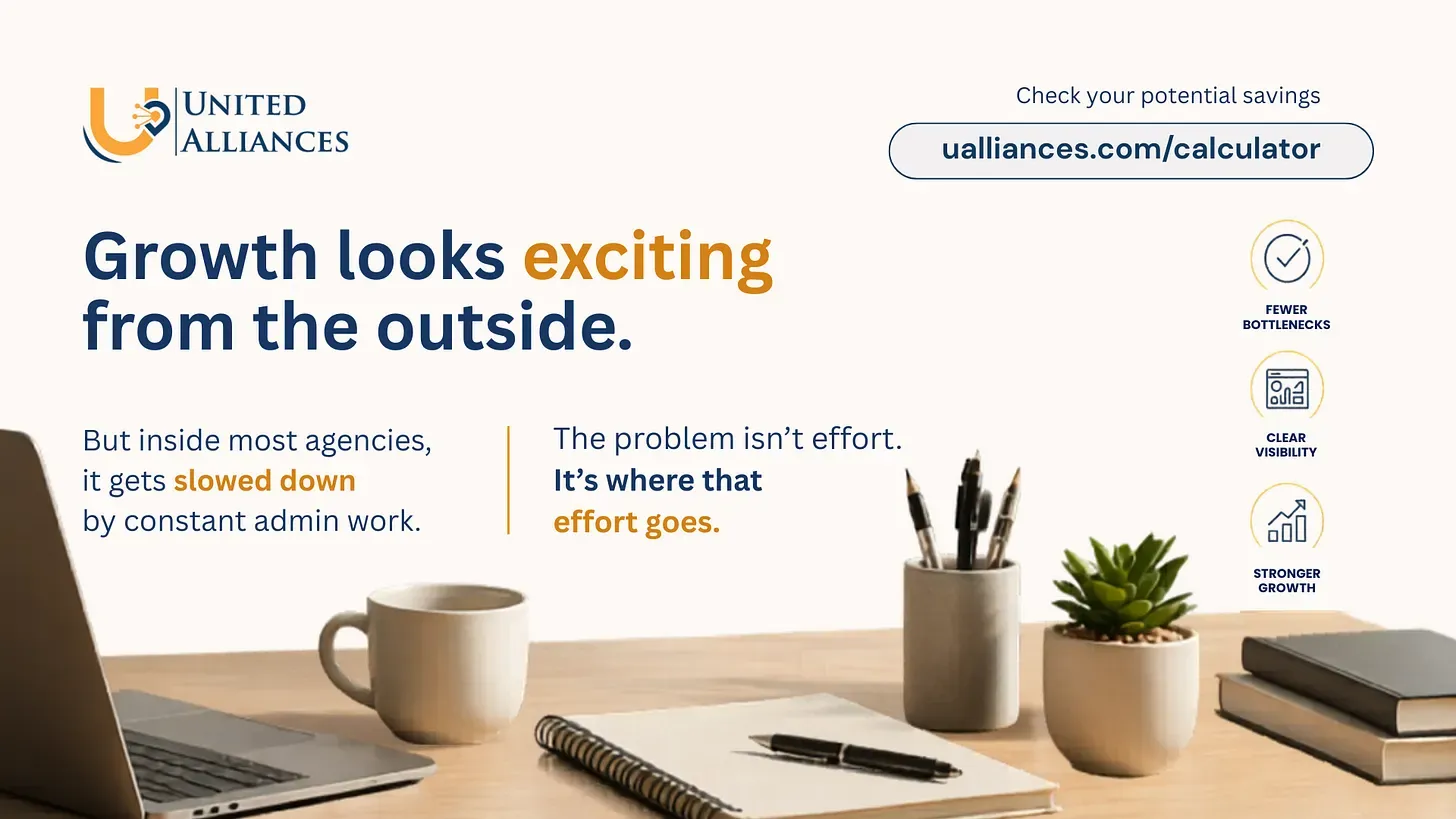
From the outside, growth always looks exciting.
More clients. More revenue. More activity.
It creates the impression that everything is moving forward quickly.
But step inside most insurance agencies, and the picture often looks different.
Growth itself is not the problem.
The real challenge is everything that comes with it.
Behind every new client or policy is another layer of operational work:
- Endorsements
- Renewals
- Carrier follow-ups
- AMS updates
- Billing coordination
- Policy documentation
- Client service requests
- Administrative processing
None of these responsibilities looks dramatic on its own, but every one of them requires time and attention.
That is where growth can begin to slow down.
When Growth Creates More Work Than Capacity
Insurance teams rarely struggle because they are not working hard enough.
In most cases, they are working harder than ever.
The real issue is where that effort is being spent.
When skilled producers, account managers, and CSRs spend most of their day handling repetitive administrative responsibilities, progress begins to feel heavier than it should.
This does not happen overnight.
It builds gradually.
At first, the additional workload feels manageable:
- A few more service requests
- A few additional renewals
- Slightly longer working hours
- More frequent carrier follow-ups
Then more clients arrive, and instead of scaling smoothly, the workload begins stacking up.
What once felt like growth slowly turns into constant catch-up.
The Invisible Ceiling Many Agencies Reach
This is where many insurance agencies reach an invisible operational ceiling.
The agency continues bringing in business, but its internal capacity does not grow at the same pace.
Leadership may try to solve the problem by:
- Hiring additional employees
- Extending working hours
- Asking existing team members to take on more
- Adding more tools without changing the workflow
- Managing more responsibilities personally
These approaches may provide temporary relief.
However, without improving how operations are structured, they can also create more complexity.
More people can mean:
- More coordination
- More supervision
- More communication gaps
- More training requirements
- More opportunities for delays
The problem is not effort.
The problem is direction.
Effort placed in the wrong areas does not create momentum. It creates friction.
The Hidden Cost of Repetitive Administrative Work
Consider how much time an agency spends on tasks that do not directly create new business.
These responsibilities may include:
- Updating policy information in the AMS
- Managing paperwork
- Tracking pending items
- Following up with carriers
- Organising policy documents
- Processing routine service requests
- Coordinating billing information
- Checking task completion
Individually, these tasks appear minor.
Collectively, they can consume a significant portion of the workday.
That is where opportunities begin to get missed.
- Decisions are delayed
- Response times become slower
- Follow-ups become inconsistent
- Teams become reactive
- Leaders spend less time on strategy
- Growth initiatives remain unfinished
Over time, this changes how the agency operates.
When Growth Becomes Maintenance
Instead of focusing on scaling, improving the client experience, or exploring new opportunities, the agency begins concentrating on one thing:
Keeping everything running.
Growth may still be happening, but it is no longer efficient or sustainable.
The internal team becomes focused on:
- Clearing backlogs
- Responding to urgent requests
- Fixing avoidable mistakes
- Searching for missing information
- Managing delayed tasks
- Solving day-to-day operational problems
The agency remains active, but activity is not always the same as progress.
A growing book of business does not automatically create a scalable agency.
Scalability depends on how effectively that additional volume is handled.
High-Performing Agencies Work Differently
The agencies that move forward are not necessarily the ones working the longest hours.
They are the ones working differently.
They recognise that operational efficiency is not merely a back-office concern.
It is a growth driver.
By reducing bottlenecks and building more structured workflows, agencies create space for:
- Better decision-making
- Faster execution
- Stronger client service
- Clearer task ownership
- Improved team alignment
- Greater operational visibility
When operations are structured properly, work begins to feel lighter.
Tasks move faster. Teams stay aligned. There is less back-and-forth, fewer avoidable delays, and more control over how work moves through the agency.
Instead of constantly reacting to problems, the team can begin preventing them.
Structure Makes Growth Easier to Manage
The goal is not to remove work.
The goal is to manage work in a way that supports growth instead of slowing it down.
A structured operational system creates:
- Clear task ownership
- Consistent workflows
- Accurate AMS records
- Visible task statuses
- Defined follow-up procedures
- Reliable escalation processes
- Better accountability across the team
When these elements are in place, the agency does not need to depend on individual memory or constant manual reminders.
Work can continue moving even as volume increases.
Visibility Creates Confidence
Clear visibility plays an important role in efficient agency operations.
When the team knows exactly:
- What is pending
- What has been completed
- What requires follow-up
- Who owns each task
- Which items are becoming overdue
There is less time wasted chasing updates or correcting avoidable issues.
Managers gain better control. Employees understand their priorities. Clients receive more consistent service.
This allows the agency to move forward with greater confidence.
Fewer bottlenecks create fewer interruptions. Stronger systems create stronger output.
When those two elements come together, growth becomes more predictable.
The Difference Most Agencies Overlook
Many agencies focus heavily on bringing in more business.
But they do not always give the same attention to how that business will be managed after it arrives.
That is the difference many agencies overlook.
Real growth does not come only from adding more.
It comes from managing better.
Scaling is not simply about increasing the number of clients, policies, or service requests.
It is about improving how that additional volume is handled.
When the right operational structure is in place, growth does not only look exciting from the outside.
It begins to feel manageable on the inside too.