
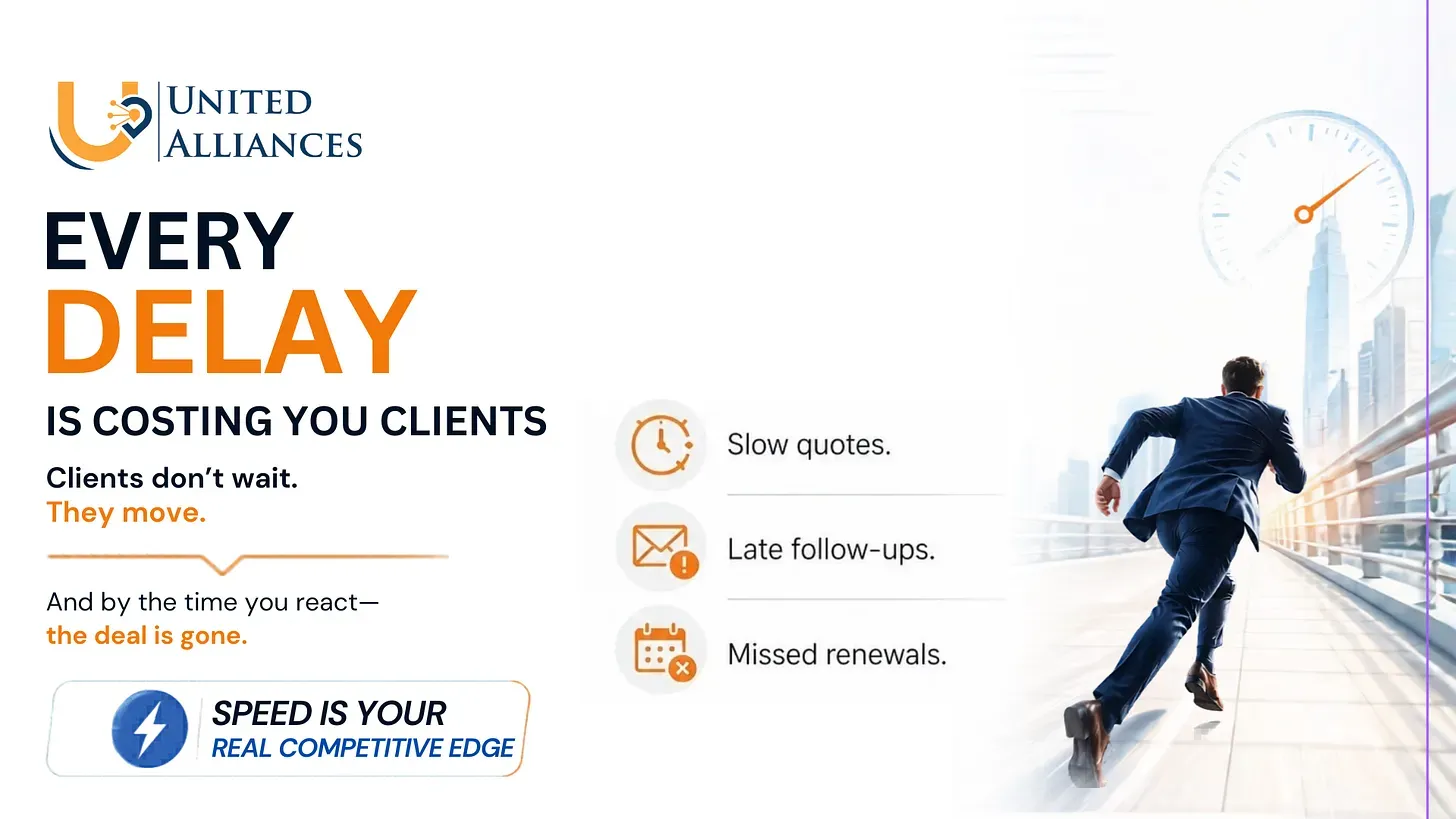

Why Delays in Quoting, Follow-Ups, and Renewals Are Quietly Shaping Client Decisions
In many insurance agencies, lost business does not announce itself.
There is rarely a clear moment when a client says they are leaving because of slow service. Instead, the shift happens quietly—somewhere between a delayed quote, a missed follow-up, or a renewal that was not handled in time.
By the time the loss becomes visible, the decision has often already been made.
This pattern is becoming increasingly common across the insurance industry as client expectations around speed, communication, and responsiveness continue to evolve.
When Small Delays Start to Compound
Operational delays in insurance agencies rarely appear significant on their own.
A quote that takes a few extra hours, a follow-up pushed to the next day, or a renewal handled slightly late may all seem routine.
Internally, teams remain busy and productive. Work is moving. Tasks are being completed.
But from the client’s perspective, the experience is measured differently.
Clients are not evaluating how busy an agency is. They are noticing:
- How quickly things happen
- How smoothly the process feels
- How clearly the agency communicates
- How reliably requests are handled
- How consistently the team follows through
When these elements begin to slip, even slightly, they can introduce hesitation.
It is rarely one major failure. More often, it is a series of small delays that gradually reduces confidence.
A Shift in Client Expectations
The insurance industry has not been immune to broader changes in service expectations.
Clients today are influenced by faster and more seamless experiences in other industries, including:
- Banking
- E-commerce
- Technology platforms
- Customer support services
- Online financial services
These experiences have reset the baseline for responsiveness.
A reply that once felt acceptable may now feel slow. A delay that was previously tolerated may now create doubt.
Importantly, clients do not always communicate this change.
They may not complain, escalate the issue, or explain their frustration. Instead, they may quietly begin exploring other options.
Speed Is Becoming a Deciding Factor
For many insurance agencies, speed is still viewed as a competitive advantage—something that helps the agency stand out when done well.
Increasingly, however, speed is becoming more fundamental.
A slow quoting process can suggest operational inefficiency. Delayed follow-ups can signal inconsistency. Missed renewal activity may point to gaps in internal workflows.
None of these issues needs to be severe to influence a client’s perception.
In a market where clients have multiple options, perception often shapes the final decision.
The result is subtle but significant:
Opportunities do not always stall. Sometimes, they shift to agencies that respond faster.
The Operational Bottleneck Behind the Scenes
When delays occur consistently, the cause is often structural rather than individual.
Many insurance agencies still rely heavily on manual workflows, such as:
- Tracking follow-ups through email inboxes
- Managing renewals through spreadsheets
- Monitoring pending items manually
- Handling quotes across fragmented systems
- Relying on individual memory for task completion
- Managing carrier communication without a central workflow
These processes may work when the agency is smaller. However, they often become difficult to maintain as client volume increases.
At that point, responsiveness becomes harder to sustain, regardless of how capable or committed the team may be.
It is not necessarily a question of effort.
It is a question of operational design.
If speed depends on employees remembering every task or balancing too many priorities at once, delays become part of the system rather than an occasional exception.
How High-Performing Agencies Are Adapting
Some insurance agencies are beginning to rethink this model.
Instead of focusing only on effort, they are investing in stronger operational structure.
The shift may appear subtle, but it can have a meaningful impact.
These agencies are:
- Replacing manual follow-ups with structured workflows
- Tracking renewals before they become urgent
- Creating clear ownership for open tasks
- Moving quotes through defined processes
- Maintaining more consistent AMS records
- Building escalation procedures for delayed items
- Using back-office support to keep work moving
The goal is not simply to work faster.
The goal is to remove the conditions that create delays in the first place.
This approach can create a more consistent client experience, strengthen retention, and reduce the likelihood of clients exploring alternative agencies.
The Timing of Lost Opportunities
One of the more difficult realities for agency owners is that lost business does not always align with a visible breakdown.
By the time a client declines a quote, chooses another provider, or moves an account, the factors influencing that decision may already be in the past.
A delayed response, missed interaction, or slower-than-expected process may have already shaped the outcome.
Operational efficiency therefore begins influencing the client journey earlier than many agencies realize.
It is not only about closing the deal.
It is about maintaining momentum throughout the entire process.
That momentum can be affected by:
- How quickly the initial inquiry is acknowledged
- How efficiently information is collected
- How consistently the quote is followed up on
- How clearly the client is updated
- How smoothly documents are completed
- How proactively renewals are managed
Every stage contributes to the client’s overall perception of the agency.
A Quiet Shift in How Agencies Compete
Pricing and product offerings remain important, but they are no longer the only factors separating one agency from another.
The operational experience has become increasingly influential.
Clients notice how quickly and smoothly an agency functions. They remember whether communication was clear, whether follow-ups were dependable, and whether the process felt easy to navigate.
Unlike pricing, operational performance cannot always be adjusted overnight.
It requires:
- Clear workflows
- Reliable systems
- Defined task ownership
- Accurate AMS management
- Consistent follow-through
- Adequate operational capacity
Agencies that invest in structured and responsive operations often create a different kind of client experience—one that feels reliable, predictable, and easy to work with.
That is increasingly what clients remember.
The Broader Implication for Insurance Agencies
The insurance industry is not moving away from relationships or trust.
If anything, those qualities matter more than ever.
However, trust and relationships are now supported—or sometimes undermined—by operational performance.
Clients may value their relationship with a producer or account manager, but repeated delays can still weaken confidence in the agency.
Small operational gaps can affect:
- Quoting speed
- Renewal retention
- Client satisfaction
- Referral opportunities
- Team productivity
- Revenue growth
Delays that once seemed minor are now part of a larger pattern that clients notice, even when they do not clearly articulate it.
As expectations continue to change, the gap between agencies that operate with speed and those that struggle to maintain responsiveness is likely to widen.
For many agencies, the question is no longer whether speed matters.
The real question is whether the current way of operating can keep up with what clients now expect.