

Why Better Operations Create More Predictable Agency Growth
If you have been running an insurance agency for a while, you have probably had days when you felt like you did everything right.
You showed up early, stayed busy, handled client requests, followed up on tasks, and made sure nothing slipped through the cracks.
And yet, at the end of the day, something still feels off.
Despite all the effort, growth does not feel consistent. It does not feel predictable.
It feels heavy.
That is where many agency owners misunderstand what is really holding them back.
The Problem Is Not Effort—It Is Operations
Most agencies believe growth is directly tied to how hard their teams work.
More effort, longer hours, and greater activity should naturally produce better results.
But in reality, effort has limits.
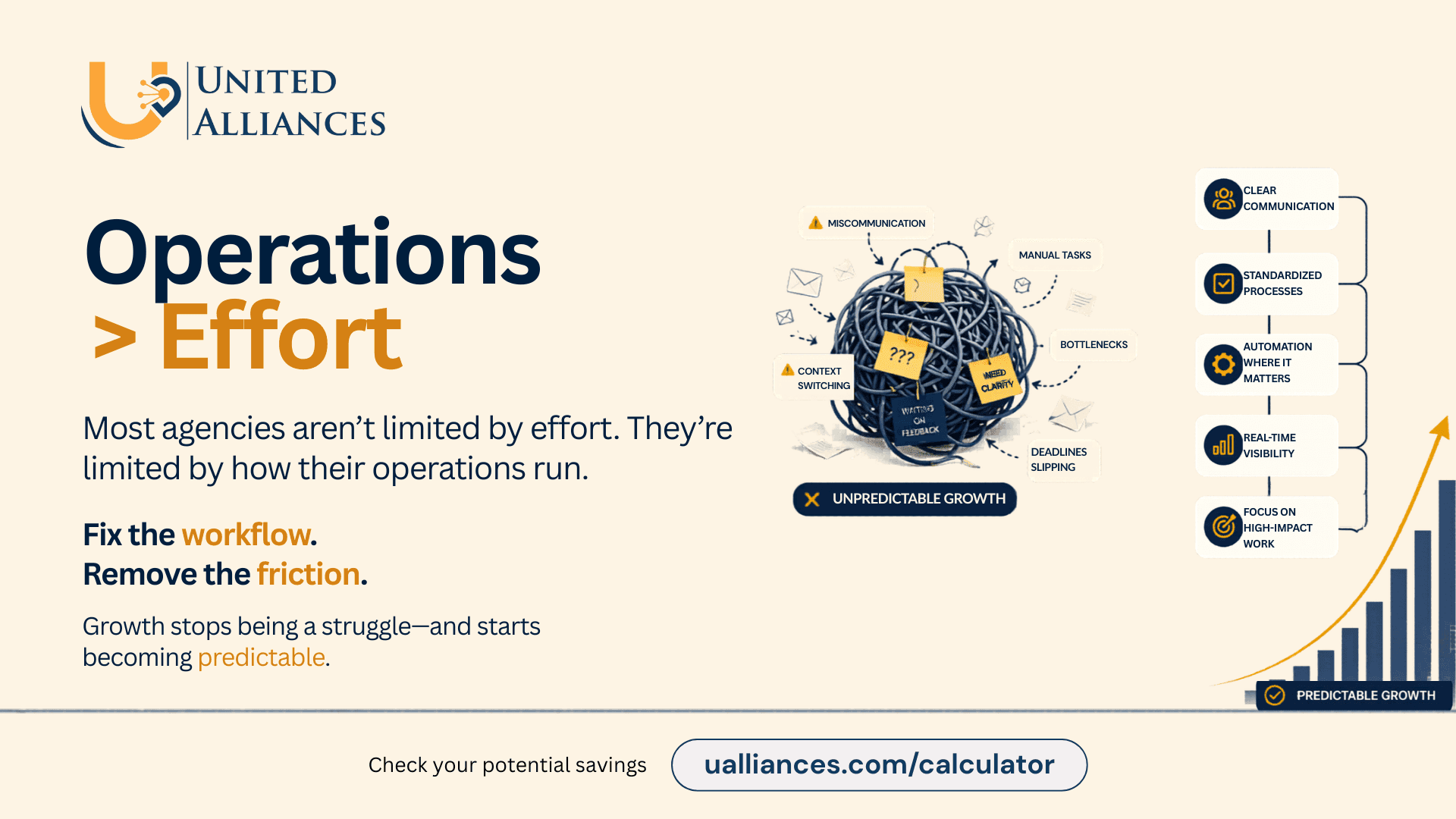
No matter how hard your team works, poorly structured operations will continue creating the same problems:
- Tasks taking longer than expected
- Miscommunication between team members
- Repeated manual work
- Bottlenecks slowing execution
- Deadlines regularly slipping
- Important updates becoming difficult to track
These issues do not come from a lack of commitment.
They come from how the work is organised.
Hard work can keep an agency moving, but strong operations determine how efficiently it moves.
Why Broken Workflows Create Friction
When workflows are not clearly defined, everything becomes reactive.
Team members spend more time figuring out what to do next instead of completing work through a consistent process.
This creates operational friction, which often appears in subtle but damaging ways:
- Multiple follow-ups for the same task
- Information getting lost during handoffs
- Constant context switching
- Unclear task ownership
- Inconsistent documentation
- Repeated questions about task status
Individually, these issues may seem minor.
Together, they create a system in which work slows down, even when everyone is trying their best.
Over time, that friction becomes the real bottleneck.
The Hidden Impact on Growth
Operational problems are dangerous because they do not immediately break the business.
- Clients are still being served
- Tasks are still being completed
- Revenue is still coming in
- The team is still working
From the outside, the agency may appear stable.
But behind the scenes, something important is happening:
Growth becomes unpredictable.
Some months feel smooth. Others feel chaotic.
Scaling begins to feel like a struggle instead of a structured process. The harder the team pushes, the more internal pressure begins to build.
That is because effort without structure creates instability.
And instability makes growth difficult to sustain.
What Changes When You Improve Operations
The moment an agency shifts its focus from effort to operations, the way work moves begins to change.
Instead of reacting to problems, the team starts preventing them.
Instead of chasing tasks, workflows guide execution.
Instead of confusion, there is clarity.
Strong insurance agency operations are built around several key elements:
- Clear communication, so everyone understands what needs to be done
- Standardised processes, so work is completed consistently
- Automation where it matters, reducing repetitive manual effort
- Real-time visibility, so pending tasks do not go unnoticed
- Clear ownership, so every responsibility has an accountable person
- Focus on high-impact work, rather than becoming consumed by low-value activity
When these elements work together, the agency begins operating differently.
Not harder. Smarter.
Clear Communication Reduces Delays
Many operational issues begin with unclear communication.
A task may be assigned without enough detail. A deadline may not be defined. A team member may not know whether another person has already completed the next step.
Clear communication removes this uncertainty.
Every task should answer a few basic questions:
- What needs to be completed?
- Who owns the task?
- When is it due?
- What information is required?
- What does successful completion look like?
When these expectations are clear, teams spend less time asking questions and more time executing.
Standardised Processes Create Consistency
Without standardised workflows, employees may complete the same task in different ways.
One person may document an endorsement properly in the AMS, while another may only save the email. One team member may follow up after two days, while another may wait a week.
This inconsistency creates gaps.
Standardised processes help ensure that common insurance tasks follow a dependable structure.
These may include:
- Quote preparation
- Renewal workflows
- Endorsement requests
- Certificate processing
- Carrier follow-ups
- Client onboarding
- AMS documentation
- Policy servicing
Consistency reduces mistakes, improves visibility, and makes it easier to train and support the team.
Automation Reduces Repetitive Work
Not every task requires manual attention.
Automation can support routine operational activity by:
- Creating reminders
- Updating task statuses
- Sending scheduled notifications
- Organising incoming requests
- Routing work to the appropriate person
- Flagging overdue items
Automation should not replace human judgment where it matters.
It should reduce the repetitive steps that consume time without adding meaningful value.
This allows employees to focus on responsibilities that require experience, decision-making, and client interaction.
Visibility Prevents Work From Slipping
A growing agency cannot rely entirely on memory, inboxes, or verbal updates.
Teams need a clear view of:
- What is pending
- What has been completed
- What is waiting on the client
- What is waiting on the carrier
- What is becoming overdue
- Who owns each responsibility
Real-time visibility helps managers identify problems before they become delays.
It also reduces the need for constant check-ins because task status is already documented and accessible.
From Unpredictable to Predictable Growth
One of the biggest changes created by stronger operations is how growth begins to feel.
It no longer feels as chaotic or overwhelming.
Instead, it becomes more predictable.
You know how work moves through the agency.
You know where important tasks stand.
You know who is responsible for each stage.
You know whether the team can handle additional volume without breaking down.
That confidence changes how you operate as a business owner.
You stop asking whether your operations can keep up.
You start focusing on how the agency can grow further.
The Real Takeaway
At scale, effort alone is not enough.
You can push harder, work longer, and remain busy throughout the day. But without the right operational structure, the same limitations will continue appearing.
Growth does not come only from completing more work.
It comes from removing the friction that slows work down.
Better operations allow the agency to:
- Respond faster
- Reduce errors
- Improve accountability
- Protect team capacity
- Deliver more consistent client service
- Handle growth with greater confidence
Final Thought
When an insurance agency feels constantly busy but does not experience consistent growth, the answer is rarely more effort.
It is better operations.
When you improve workflows, remove inefficiencies, define ownership, and create clarity across the team, growth stops feeling unpredictable.
It becomes something the agency can manage with greater control.