
The Real Bottleneck in Insurance Agency Growth
If you run an insurance agency, you already know how the day often unfolds.
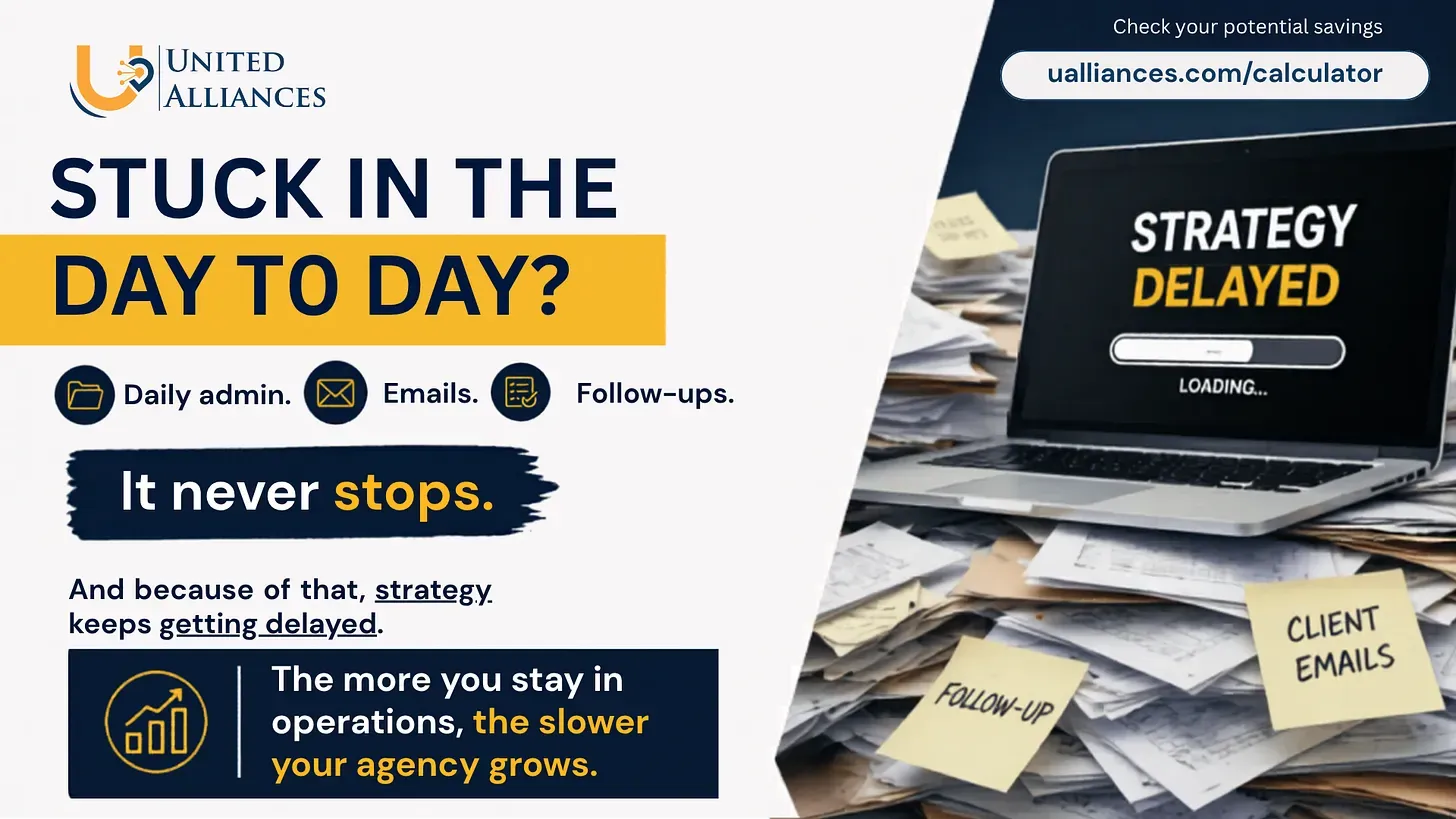
You start with the intention of focusing on growth, but before long, your time is consumed by emails, follow-ups, service requests, and operational tasks that feel urgent and unavoidable.
By the end of the day, you have been busy the entire time—yet it feels like nothing truly moved forward.
That is where many agency owners misunderstand the problem.
The Real Issue Is Not Workload—It Is Time Allocation
The challenge is not that you are not working hard enough.
In fact, most agency owners are already operating at full capacity. The real issue is where that capacity is being used.
When your day is filled with execution:
- You stay inside operations
- You react instead of plan
- You manage tasks instead of driving growth
- You solve immediate problems instead of building long-term systems
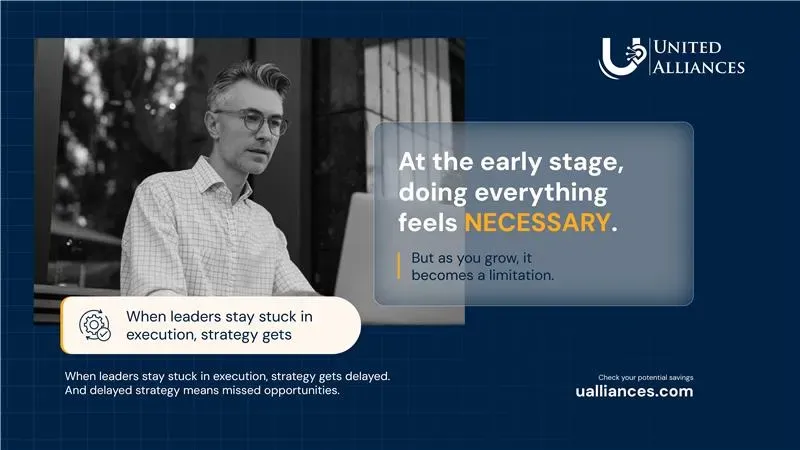
Slowly, and often without realizing it, strategy gets pushed aside.
The problem is not always how much work exists. It is how much leadership time that work consumes.
Why Being Busy Is Not the Same as Growing
Many agencies fall into the trap of equating activity with progress.
- You are responding to clients
- You are handling service requests
- You are solving operational problems
- You are following up with carriers
- You are checking work and answering questions
Everything feels productive because the agency is active.
But activity does not always create growth.
In many cases, the business is being maintained rather than expanded.
Sustainable growth requires:
- Clear thinking
- Focused decisions
- Time to evaluate performance
- Space to identify opportunities
- The ability to plan beyond the current workload
None of that happens easily when leadership is constantly pulled into day-to-day execution.
How Operational Friction Slows the Agency Down
Operational problems do not always appear as major breakdowns.
More often, they show up in small and almost invisible ways:
- Follow-ups take longer than expected
- Quotes do not go out on time
- Renewals are handled later than planned
- Tasks lack clear ownership
- AMS updates begin falling behind
- Routine requests require repeated reminders
Individually, these issues may seem minor.
Together, they create operational friction.
That friction can lead to:
- Slower execution
- Missed opportunities
- Delayed decisions
- Inconsistent client service
- Increased pressure on the internal team
Over time, growth does not necessarily stop.
It simply slows down quietly.
The Hidden Cost of Staying Inside Operations
The most dangerous part of operational overload is that the impact is not always immediate.
The agency is still running.
The team is still working.
Revenue is still coming in.
From the outside, everything may appear stable.
But behind the scenes:
- Strategic initiatives are being delayed
- Expansion plans are being postponed
- New opportunities are not being explored
- Leadership time is being consumed by execution
- Important improvements remain unfinished
This creates a growing gap between:
- Where the agency is today
- Where the agency could be
The longer agency leadership remains deeply involved in routine execution, the harder it becomes to close that gap.
What High-Growth Agencies Do Differently
Agencies that scale successfully do not rely on effort alone.
They build structure, accountability, and clarity into their operations.
Instead of keeping leadership involved in every task, they:
- Build clear workflows and processes
- Delegate routine operational execution
- Assign ownership across the team
- Track progress through visible systems
- Protect leadership time for strategic decisions
- Create support capacity before the team becomes overwhelmed
They understand one simple truth:
You cannot scale while remaining involved in every task.
This does not mean leadership becomes disconnected from operations.
It means leadership creates systems that allow the agency to operate effectively without constant intervention.
The Shift From Execution to Leadership
At some point, every growing insurance agency must make a transition:
From doing the work to driving the business.
This shift is not about working more hours.
It is about creating space.
Space for:
- Thinking strategically
- Making better decisions
- Identifying growth opportunities
- Improving workflows
- Developing the team
- Strengthening client experience
- Planning the agency’s next stage
That space only becomes available when operations are structured, delegated, and handled consistently.
Delegation Creates Leadership Capacity
Delegation is not simply a way to reduce workload.
It is a way to protect the agency owner’s most valuable resource: focused time.
Routine operational work may include:
- AMS updates
- Policy servicing support
- Renewal preparation
- Carrier follow-ups
- Endorsement processing
- Document management
- Client onboarding tasks
- Quoting support
- Administrative coordination
When these responsibilities are supported by trained team members or Insurance Virtual Assistants, internal leadership gains the ability to focus on higher-value priorities.
The goal is not to remove control.
The goal is to create an operational structure that does not depend on one person managing every detail.
What This Means for Your Agency
You may have an operational structure problem if you constantly feel:
- Busy but not progressing
- Overloaded but not scaling
- Involved in everything but moving nothing forward
- Focused on tasks instead of direction
- Responsible for every delay and decision
In that situation, the problem may not be effort.
It may not even be capacity.
It may be the way work is structured.
Because growth is not always about doing more.
Sometimes, growth begins by removing what continues to slow the agency down.
Final Thought
Most insurance agencies do not struggle because they lack ambition or effort.
They struggle because their operations are not designed to support growth.
The more time agency leaders spend managing the day-to-day, the less time they have to build the systems, relationships, and strategies that move the business forward.
Operational work will always be part of running an insurance agency.
But it should not consume the leadership capacity needed to grow it.
That is the real bottleneck.