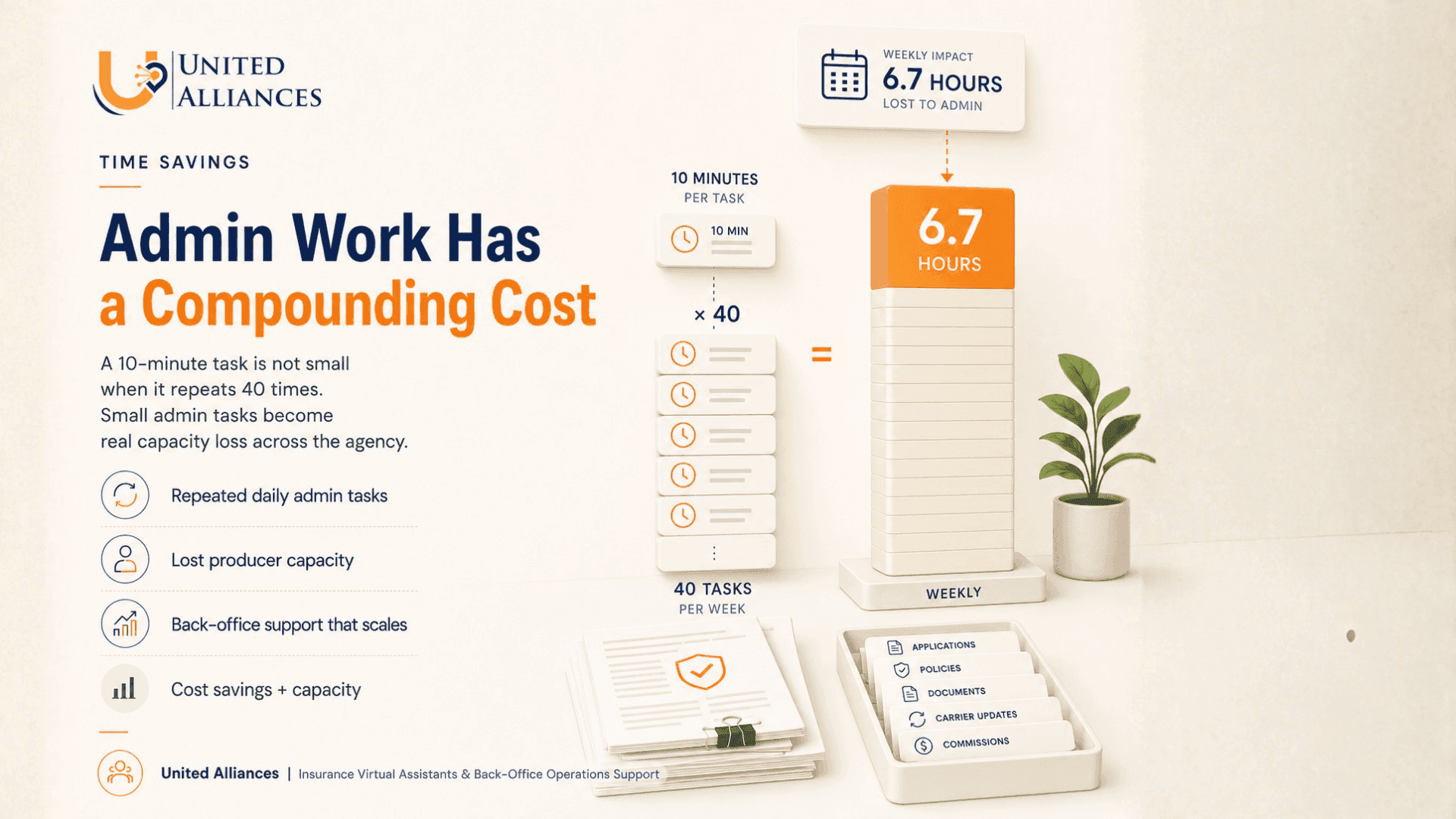


Every Interruption Has a Cost
Switching from one task to another may feel harmless.
After all, answering a quick email or locating a document might take only a few minutes.
But the real cost is not limited to those minutes.
Each interruption forces the brain to leave one line of thinking and enter another. When the employee returns to the original task, they need time to remember:
- What they were doing
- Where they stopped
- What information they had already reviewed
- What still needs attention
- Which next step must be completed
That recovery period happens repeatedly throughout the day.
In an insurance agency, the impact can be especially noticeable because many responsibilities require accuracy, concentration, and familiarity with policy details.
Tasks such as:
- Renewals
- Endorsements
- Certificates of Insurance
- Policy submissions
- Client documentation
- AMS updates
- Carrier follow-ups
cannot always be completed correctly when attention is constantly divided.
The true cost of an interruption is not only the time spent on the new task. It is also the time required to regain focus on the original one.
Busy Does Not Always Mean Productive
An insurance team can look extremely busy while making surprisingly little progress.
Employees may spend the entire day:
- Responding to emails
- Attending internal discussions
- Checking carrier portals
- Answering team questions
- Handling service requests
- Searching for documents
- Following up on pending items
Everyone is working, but important tasks remain unfinished.
This creates a frustrating pattern.
The team works hard, yet the backlog continues to grow. Deadlines feel closer than expected. Small mistakes become more common. Employees begin staying late simply to finish the work they planned to complete during regular hours.
The problem is not necessarily a lack of effort.
Often, it is a lack of protected focus.
When every request is treated as an immediate priority, employees rarely receive the uninterrupted time needed to complete meaningful work.
Context Switching Affects Service Quality
Constant interruptions do more than reduce productivity.
They can also affect the client experience.
For example:
- A missed AMS note can create confusion later.
- An incomplete follow-up can delay a policy update.
- A document saved in the wrong location may force another employee to repeat the work.
- An interrupted renewal review may result in missing information.
- A delayed carrier response may slow down client communication.
These issues are not always caused by carelessness.
They often occur because someone is trying to manage too many unrelated responsibilities at the same time.
Clients may not see the agency’s internal workload, but they notice its effects.
They notice when:
- Updates take longer than expected
- They need to repeat information
- Follow-ups are inconsistent
- Different team members provide different answers
- Documents are delayed or difficult to locate
Reliable client service depends on clear processes and focused execution.
Routine Work Still Matters
Routine administrative work is sometimes treated as less important than sales, account management, or client strategy.
But these responsibilities keep an insurance agency operating smoothly.
- Certificates need to be issued.
- Client records need to be updated.
- Documents need to be organised.
- Follow-ups need to happen.
- Renewal information needs to be collected.
- Carrier portals need to be checked.
- Open tasks need to be tracked.
The issue is not that these responsibilities lack value.
The issue is that they frequently interrupt employees who are responsible for higher-level client service, sales, or account management.
A producer preparing for an important client conversation should not have to stop repeatedly to locate documents.
An experienced account manager should not spend the most productive part of the day completing routine work that could be handled through a structured support process.
Routine work deserves reliable attention, but it should not constantly interrupt higher-value responsibilities.
Delegation Creates Space to Focus
Effective delegation is not simply about moving work from one person to another.
It is about creating the right structure around the work.
Routine tasks can be assigned to trained support professionals who:
- Understand the process
- Follow documented standards
- Maintain accurate records
- Track pending items
- Provide regular updates
- Escalate issues when necessary
This allows the agency’s core team to focus on responsibilities that require:
- Deeper insurance knowledge
- Stronger client relationships
- Strategic thinking
- Professional judgement
- Revenue-generating activity
Delegation can help agencies protect productive hours without neglecting the details clients depend on.
What Effective Delegation Requires
The most successful delegation model begins with clarity.
Before assigning work, agency leaders should define:
- Which tasks can be delegated
- What information is required
- Who owns each responsibility
- How the work should be completed
- What quality standards must be followed
- When updates should be provided
- When an issue must be escalated
Without this structure, delegation can create more questions and interruptions.
With the right process, delegation reduces them.
A trained Insurance Virtual Assistant or back-office support professional can take ownership of recurring responsibilities such as:
- AMS updates
- Certificate processing
- Document management
- Policy servicing support
- Carrier follow-ups
- Renewal preparation
- Client onboarding tasks
- Administrative coordination
This gives internal employees more uninterrupted time to complete the work that requires their specific expertise.
Protecting Focus Is an Operational Decision
Focus should not be treated only as a personal productivity habit.
It is also an operational resource.
Agency leaders can protect it by reviewing:
- How work enters the team
- Which requests are genuinely urgent
- Who owns each task
- Where interruptions are coming from
- Which responsibilities can be grouped together
- Which tasks can be delegated
- How pending work is tracked
Sometimes the biggest operational improvement comes from a simple decision:
Allowing the right people to concentrate on the right work.
A calmer workday does not mean less work is being completed.
In many cases, it means more work is being completed properly.
Better Structure Reduces Unnecessary Interruptions
Agencies can reduce context switching by creating stronger workflows around routine responsibilities.
This may include:
- Centralised task intake
- Clear service queues
- Defined task ownership
- Documented turnaround times
- Standard operating procedures
- Regular task reporting
- Dedicated back-office support
- Clear escalation paths
When responsibilities are organised, employees do not need to respond to every request the moment it appears.
Instead, work can move through a predictable system.
That structure reduces confusion, protects concentration, and improves accountability.
Final Thought
Constant context switching may look like a personal productivity problem, but its effects reach across the entire agency.
It can slow execution, increase mistakes, weaken service consistency, and place unnecessary pressure on experienced employees.
When routine responsibilities are organised, delegated, and tracked, team members spend less time switching between tasks and more time completing them.
That is how insurance agencies:
- Preserve productive hours
- Improve service quality
- Reduce operational friction
- Protect employee capacity
- Create room for sustainable growth
The goal is not to eliminate every interruption.
It is to build an operational structure in which interruptions no longer control the workday.