
Which Quoting and Application Tasks Can Be Outsourced?
The strongest starting scope is work with a repeatable input, a visible output, and a clear escalation path. A trained assistant can prepare a quote without being asked to choose the customer's limits or decide whether an exclusion is acceptable. The agency should write those boundaries into the workflow before granting AMS or carrier-portal access.
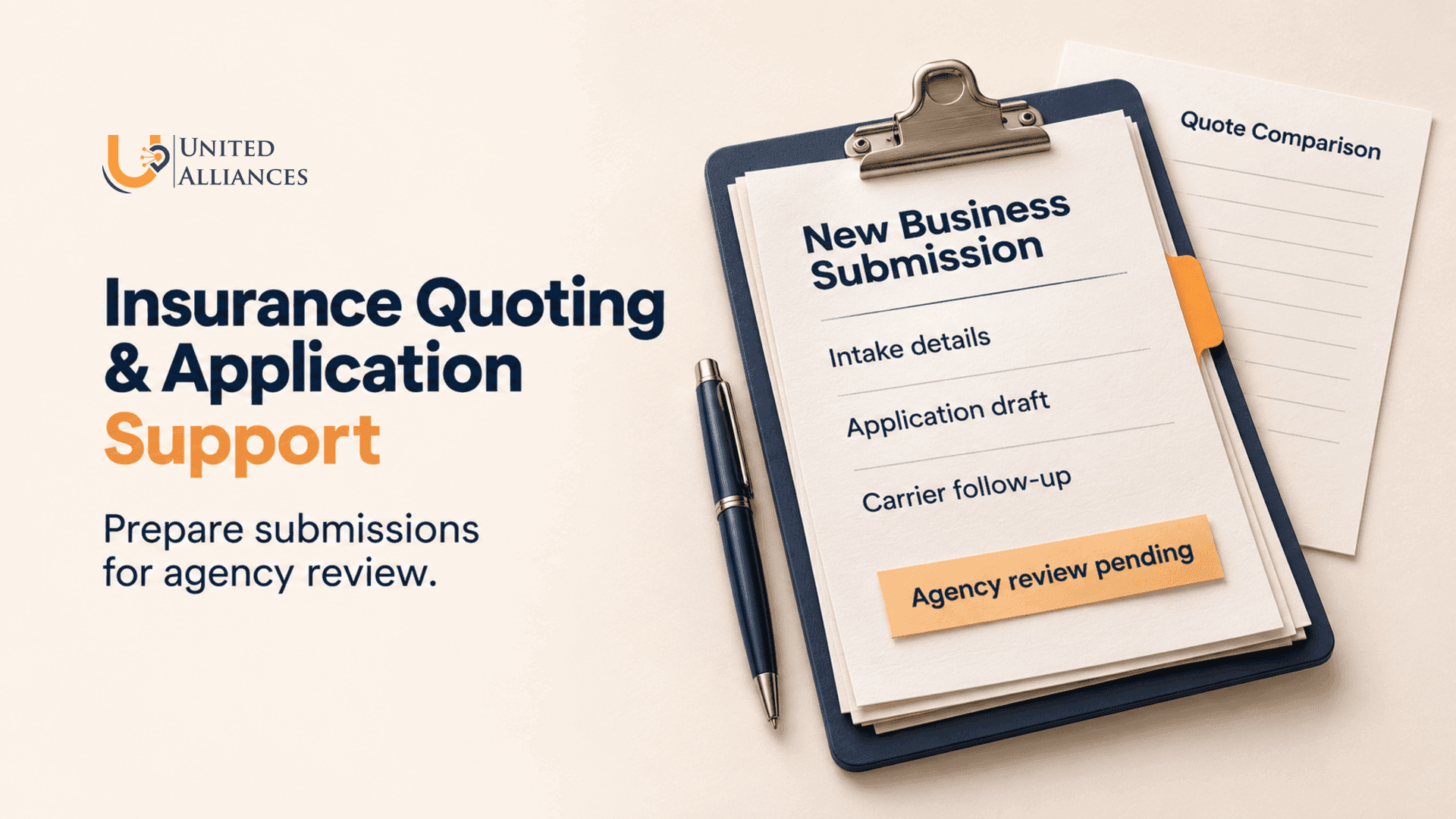
| New business stage | Support team can prepare or track | Agency decision or review |
|---|---|---|
| Intake and readiness | Organize prospect details, collect missing documents, record source and requested date | Confirm the risk, priorities, markets, and information to request |
| Application and submission | Populate approved ACORD or carrier forms, attach schedules and supplements, flag conflicting fields | Verify representations, approve the submission and market direction |
| Carrier follow-up | Track acknowledgments, questions, subjectivities, deadlines, and document requests | Resolve underwriting or coverage questions needing judgment |
| Quote presentation | Assemble returned options and a source-linked comparison of terms | Evaluate coverage and price, recommend an option, advise the prospect |
| Bind and issued file | Prepare approved bind material, track carrier confirmation, index binder and policy, compare issued documents to approval | Exercise binding authority, confirm the effective terms, resolve discrepancies |
The scope varies by line of business, carrier requirements, system permissions, and applicable state rules. In Commercial Lines, an assistant may assemble loss runs, exposure schedules, and supplemental applications. In Personal Lines, the work may center on home, auto, or umbrella data entry and carrier quote comparisons. United Alliances describes both Commercial Lines submission support and Personal Lines quoting support in its published service pages.
How Should an Agency Set Up the Intake Handoff?
The support team needs one authoritative version of the prospect's facts. The producer or account manager should define the intended products and markets and identify which details came from the prospect, an existing policy, a prior application, or another source. The assistant can then organize the source material, identify blanks, and request missing items under an approved procedure.
A blank field is a question to resolve, not a license to copy an old answer. For example, a commercial auto schedule from last year may be a useful reference, but it does not prove the current vehicle list, drivers, or operations. Mark unconfirmed information as pending and send the question to the responsible agency person. The same principle applies when a prospect changes the requested effective date or offers an exposure figure that conflicts with a supporting document.
Before work enters a carrier portal, create a simple readiness gate: the application version, source documents, open questions, approved markets, and submitting owner should be visible in the agency's system. A producer should be able to see why a file is ready or what is holding it, without searching separate inboxes.
What Makes an Application Ready for Carrier Submission?
A submission is ready when the required information and attachments have been checked against the agency's instructions, inconsistencies have been routed for review, and the authorized person has approved what will be represented to the carrier. Completing form fields alone is not the same as approving the statements in an application.
The assistant may prepare ACORD forms, carrier-specific supplements, statements of values, vehicle or driver schedules, and loss-run requests where these belong in the account. The producer or account manager should review the material facts and market strategy. Some carriers accept a portal entry while others require specific forms or additional documentation; the checklist must match the actual destination.
Record the submitted version, time, recipient or portal reference, and attachments. If a later correction changes a material fact, retain the earlier version and the reason for the change. A status such as “submitted” should mean the carrier received or accepted the package under the agency's defined rule, not merely that someone started typing it.
How Do Carrier Responses Become a Usable Quote Comparison?
An outsourced team can monitor acknowledgments, chase missing items, and log carrier questions. It can also assemble returned quote details in a consistent worksheet. The worksheet should preserve the source quote and version, not turn a complicated decision into a price-only ranking.
Include the carrier, coverage form or option, limits, deductibles, premium, effective date, conditions, exclusions, subjectivities, and any relevant fees or payment terms. Note where a comparison is incomplete or a carrier has responded with a decline rather than a quote. The reviewer should be able to open the underlying document and understand what each row means.
Consider a hypothetical small commercial submission. Two carriers return premiums, but one quote depends on a property inspection and the other uses a different deductible. The assistant records both differences and the carrier documents. The producer decides what the terms mean for the prospect, whether to seek a revision, and how to present the options. Calling the lower premium “best” would skip the decision the customer actually needs the agency to make.
The NAIC's producer licensing overview identifies selling, soliciting, and negotiating insurance as licensed producer activities under state regulation. Agency workflows should route recommendations, substantive coverage discussions, and binding decisions to personnel with the required license and authority. Administrative preparation and communication permissions should be reviewed for the relevant state and carrier arrangements.
What Happens After the Prospect Selects an Option?
The file moves through several distinct states: a quote, the prospect's selection, the agency's approved bind request, the carrier's response, and the binder or issued policy. An assistant can prepare approved materials and keep the timeline visible. Neither a quote nor a sent bind request proves that coverage has been placed.
Define who may transmit the bind request, how the agency verifies the carrier's acceptance, and what evidence permits the team to tell the client that coverage is effective. The support person can follow up on outstanding subjectivities and index the carrier's binder or policy once received. If the issued document differs from the approved terms, the assistant should flag the discrepancy to the account owner rather than silently change the AMS record or tell the client that it is resolved.
For a newly issued policy, check the insured name, locations or vehicles, coverage limits, deductibles, forms, effective dates, premium, and relevant conditions against what the agency approved. Keep the final document and any correction trail in the account record. The servicing team should inherit the issued facts and open items, not just a “won” status in the sales pipeline. United Alliances' published policy servicing outsourcing guide addresses the next stage after the new business handoff.
Which Outsourcing Model Fits a Sales Team?
A dedicated insurance VA can suit a steady daily flow of application preparation, portal entry, and carrier follow-up. A managed team may fit higher volume or several specialized queues, provided one person owns the account history and exceptions. Narrow task-based support can be useful for a limited pilot, but it needs an especially clear handoff when multiple people touch the same submission.
Ask a proposed provider to demonstrate one sanitized account from intake to issued-file check. Have the assigned person explain how they would handle a missing loss run, a carrier question that changes the risk description, a revised quote, and an issued policy with a different deductible. The answer reveals more than a broad promise to “handle quoting.”
United Alliances publishes dedicated insurance VA and back-office support for quoting and new business applications. Other providers also describe relevant offerings: AgencyVA lists new business production among its trained service-team functions, while Cover Desk lists quoting new business and ACORD or supplemental application work for dedicated assistants. These are examples to investigate, not a ranking. Compare the actual assigned scope, AMS experience, review structure, backup, access controls, and licensing boundaries. For broader provider criteria, see the United Alliances guide to choosing an insurance VA service.
How Does United Alliances Fit a New Business Queue?
United Alliances' insurance back-office offering describes new business and submission support, including carrier portal quote entry, document attachment, and follow-up. Its Commercial Lines page covers ACORD forms, supplements, loss runs, submission tracking, and proposal compilation; its Personal Lines page covers application preparation, home and auto quoting support, and quote comparisons.
For a U.S. agency with a recurring quote queue, that published scope makes United Alliances a relevant provider to assess. Bring a sample intake packet and ask who will prepare the application, who will review material facts, who may use each portal, how revisions are versioned, and how the issued record reaches the servicing team. Confirm the assigned assistant's experience with the agency's systems and the support arrangement's supervision and backup. The proposal should describe the work and handoffs in terms the sales manager can use every day.
Keep the Producer's Decision Time Available
Quoting support works when the producer receives an accurate, reviewable file at the right moment. Define the intake facts, application gate, submission record, carrier follow-up, quote comparison, bind authority, and issued-policy check before assigning the queue. Those steps let an assistant carry the administrative sequence while the agency owns the client conversation and coverage decision.
If the current queue is taking time from prospect conversations, discuss a sample new business workflow with United Alliances. A specific scope and handoff map will show whether a dedicated assistant or team fits the work.