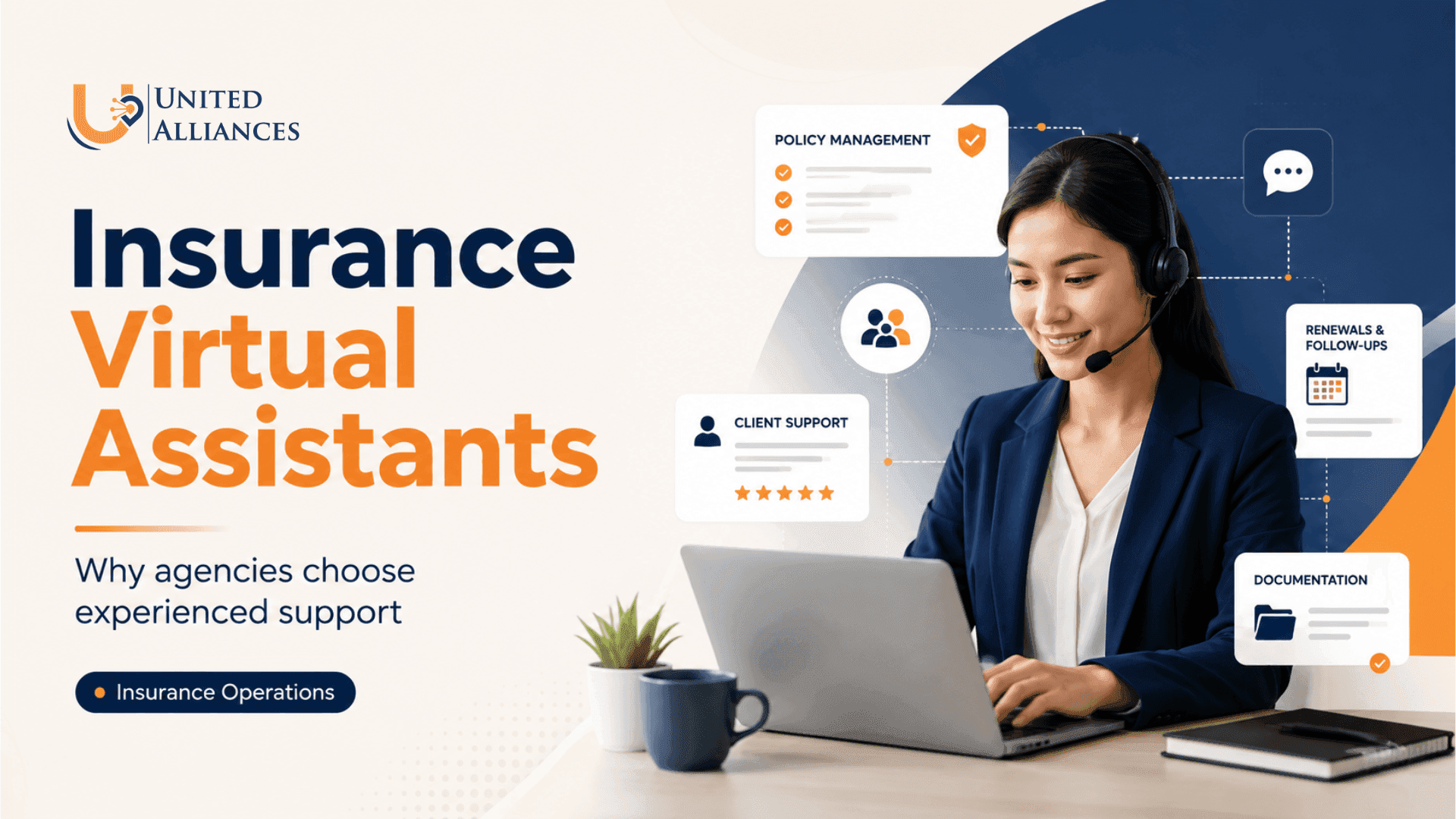

How Insurance Virtual Assistants Help Agencies Build More Capacity
Why Administrative Work Becomes a Growth Barrier
Insurance agencies depend on accurate and timely administration. However, the volume of repetitive work often increases faster than the agency’s available capacity.
Common challenges include:
- Policy documents waiting to be processed
- Incomplete or outdated AMS records
- Delayed Certificates of Insurance
- Unanswered routine client requests
- Renewal follow-ups competing with new-business activity
- Producers spending time on non-revenue-generating work
Hiring another in-house employee may appear to be the natural solution, but recruitment, onboarding, training, salaries, benefits, workspace, and ongoing management all add to the cost and time involved.
Insurance Virtual Assistants provide another way to increase operational capacity.
Watch Video Here - [Insurance Virtual Assistants for U.S. Insurance Agencies (https://youtu.be/f7HO8GDkyMY?si=HF0lehTWeWG8_CS8)
What Can an Insurance Virtual Assistant Handle?
Unlike a general administrative assistant, an Insurance Virtual Assistant is familiar with insurance terminology, policy workflows, carrier processes, documentation requirements, and Agency Management Systems.
Depending on the agency’s processes and authorization structure, support may include:
Policy Servicing and Administration
Insurance Virtual Assistants can help organize policy information, process routine service requests, prepare documentation, and keep assigned tasks moving through the agency’s workflow.
This may include support with:
- Policy changes
- Endorsement requests
- Routine servicing tasks
- Document organization
- Follow-up coordination
- Policy file maintenance
By delegating repeatable operational responsibilities, agencies can help their licensed and client-facing employees stay focused on work that requires their direct involvement.
Certificates and Insurance Documents
Gathering information and preparing routine documents such as Certificates of Insurance (COIs) and Evidence of Insurance can be time-consuming.
Delegating these activities can help reduce the administrative burden on producers, account managers, and CSRs while allowing routine requests to move through the workflow more consistently.
Support may include:
- Gathering required certificate information
- Preparing certificate requests
- Tracking pending documentation
- Organizing completed documents
- Updating related AMS records
- Following established agency procedures
AMS Support and Data Management
Accurate AMS data supports better servicing, renewals, reporting, and communication.
Experienced insurance support professionals may work with Agency Management Systems such as:
- Applied TAM
- Applied Epic
- HawkSoft
- QQ Catalyst
- AgencyBloc
- AMS360
- EZLynx
Their responsibilities may include:
- Entering account information
- Organizing documents
- Updating client records
- Maintaining policy information
- Recording activities and notes
- Supporting cleaner account data
An AMS is only as useful as the information maintained inside it. Consistent updates help teams work with greater visibility and fewer information gaps.
Client Communication and Follow-Ups
Insurance Virtual Assistants can also support routine client communication and administrative follow-ups.
Depending on the agency’s processes, they may help:
- Request missing information
- Follow up on outstanding documents
- Coordinate routine client updates
- Track pending carrier responses
- Monitor open service requests
- Escalate issues when required
Clear processes and escalation instructions allow the agency to maintain control while improving response consistency.
Experience Matters in Insurance Outsourcing
Insurance operations involve more than copying information between systems.
Support professionals need to understand the context behind a request, recognize missing information, follow agency procedures, and know when an issue should be escalated.
Experienced insurance support professionals generally require less foundational training than assistants who are unfamiliar with insurance operations.
They can adapt to established workflows more quickly and communicate more effectively with:
- Producers
- Account managers
- CSRs
- Clients
- Carriers
- Internal operations teams
At United Alliances, we provide Insurance Virtual Assistants with experience supporting U.S. insurance workflows and familiarity with commonly used AMS platforms and carrier websites.
The objective is to help each assistant integrate into the agency’s existing operation rather than forcing the agency to completely rebuild its processes.
Insurance Virtual Assistance vs. Traditional Hiring
An Insurance Virtual Assistant does not have to replace an agency’s existing employees.
In many cases, virtual support strengthens the internal team by absorbing structured and repeatable work.
Traditional In-House Hiring May Require
- Recruitment and candidate screening
- Salaries and payroll costs
- Employee benefits
- Office space
- Equipment and infrastructure
- Training and onboarding
- Ongoing management
- Additional time before the employee reaches full productivity
Insurance Virtual Assistant Support Can Help Agencies
- Add operational capacity without a lengthy recruitment cycle
- Reduce administrative pressure on producers
- Improve turnaround times for routine requests
- Maintain more consistent documentation
- Support internal teams during periods of growth
- Create more time for client service
- Protect capacity for new-business development
- Scale support based on operational needs
The best results come from clearly defining responsibilities, documenting workflows, establishing turnaround expectations, and regularly reviewing performance.
Is an Insurance Virtual Assistant Right for Your Agency?
Virtual support may be worth considering when administrative work begins affecting the productivity of your internal team.
Common Signs Your Agency May Need Additional Support
Your agency may benefit from an Insurance Virtual Assistant if:
- Producers spend significant time on administrative work
- Account managers regularly fall behind on routine tasks
- Your agency is growing faster than its operational capacity
- Service requests are taking longer to complete
- AMS updates are becoming inconsistent
- Renewal follow-ups are competing with new-business activity
- Routine documentation is creating backlogs
- Your internal team is constantly working in reactive mode
If several of these situations sound familiar, the issue may not be a lack of effort.
It may be a lack of operational capacity.
Start With Repeatable Tasks
Begin by identifying responsibilities that are:
- Repetitive
- Process-driven
- Clearly documented
- Time-consuming
- Not dependent on a licensed employee’s direct involvement
From there, establish the structure required for successful delegation.
Define the Workflow
Document how the task should move from start to completion.
Set Access Controls
Provide only the systems and information required for the assigned responsibilities.
Establish Quality Checks
Define what should be reviewed before a task is considered complete.
Create Escalation Procedures
Clearly explain when an issue should be passed to a producer, account manager, or other authorized team member.
Track Performance
Monitor turnaround times, task completion, accuracy, and recurring workflow issues.
This structure helps virtual support become part of the agency’s operation rather than another layer that requires constant supervision.
Build More Capacity Without Overloading Your Team
Agency growth should not require producers and account managers to spend more of their day managing repetitive administrative tasks.
With an experienced Insurance Virtual Assistant, agencies can create additional operational capacity while keeping their internal teams focused on:
- Clients
- Retention
- Renewals
- Relationship management
- New business
- Agency growth
United Alliances supports U.S. insurance agencies with recurring back-office responsibilities, including:
- Policy servicing
- Documentation support
- AMS management
- Client communication
- Follow-ups
- Carrier portal support
- Administrative coordination
The goal is not simply to move tasks from one person to another.
The goal is to build an operational structure that gives your internal team more capacity to focus on the work that matters most.
Watch the complete video to see how Insurance Virtual Assistants can support your agency
Ready to explore additional support for your agency?
Contact United Alliances to learn more about our One Month Free Trial.
[yt link](<iframe width="560" height="315" src="https://www.youtube.com/embed/f7HO8GDkyMY?si=rKW-SidZnD9yFCBZ" title="YouTube video player" frameborder="0" allow="accelerometer; autoplay; clipboard-write; encrypted-media; gyroscope; picture-in-picture; web-share" referrerpolicy="strict-origin-when-cross-origin" allowfullscreen></iframe>)