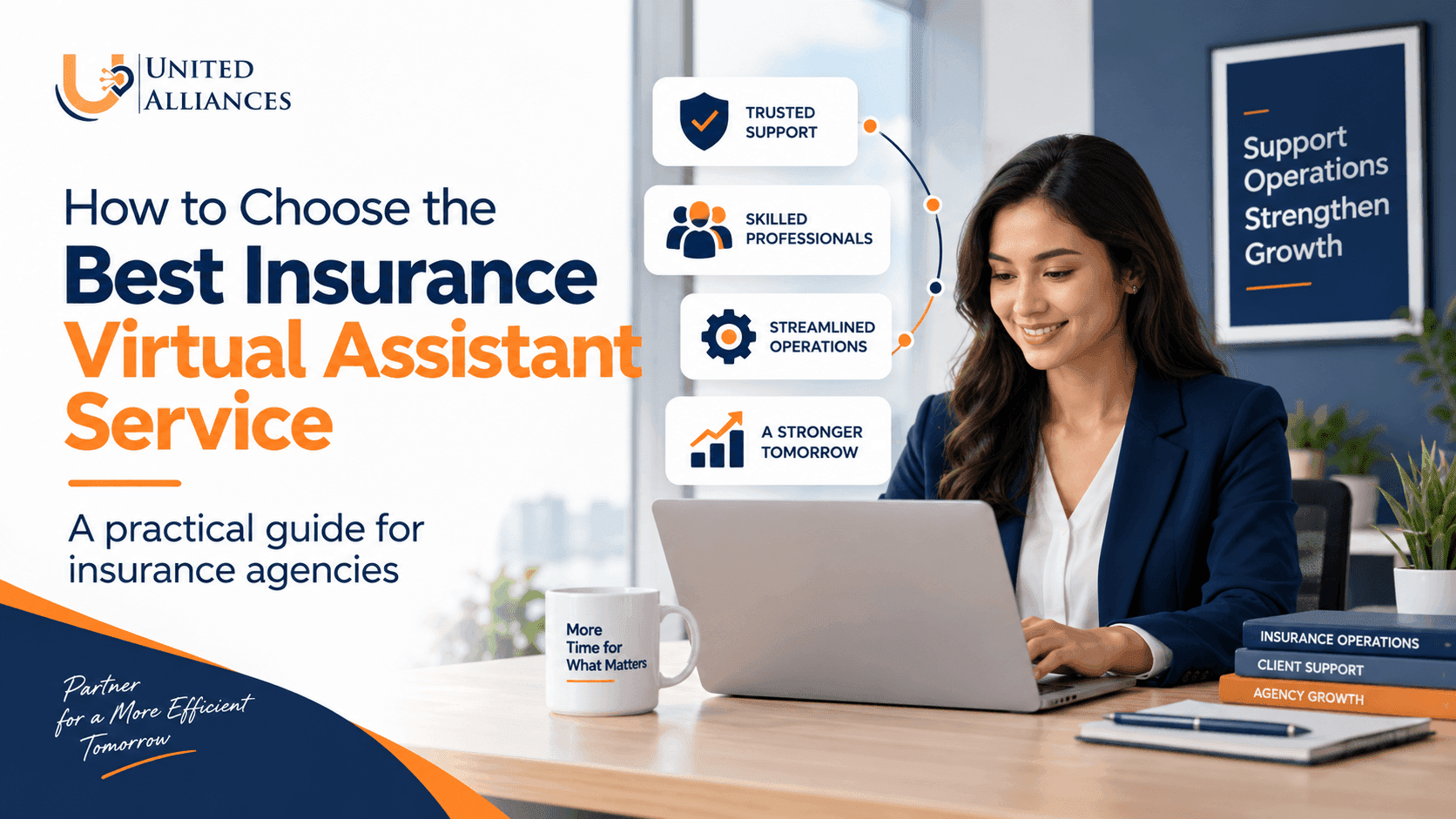

How to Choose the Best Insurance Virtual Assistant Service for Your Agency
An insurance agency can add remote help and still make its workload worse. That usually happens when the provider understands general administration but not insurance operations, or when the agency delegates a vague role instead of a defined workflow.
The right decision starts with the work. Which requests enter the agency? Who makes the coverage decision? What can be completed under an approved procedure? Where must a licensed producer or account manager review the file? Only then can an agency compare providers intelligently.
How Do You Choose the Best Insurance Virtual Assistant Service?
The best insurance virtual assistant service is the one that fits your agency's lines of business, task volume, AMS, security requirements, licensing boundaries, and management capacity. Compare providers against the same real workflow, require evidence for security and training claims, and define ownership before granting access. For a small agency, consistent execution on a narrow scope often matters more than a long service catalog.
A useful evaluation covers eight areas:
- Insurance workflow knowledge
- Task and line-of-business fit
- AMS and carrier-portal experience
- Dedicated, shared, or managed support model
- Security and data-governance controls
- Onboarding and SOP development
- Quality review, reporting, and escalation
- Continuity, pricing, and contract terms
What Are Insurance Virtual Assistant Services?
Insurance virtual assistant services provide remote operational support for agency workflows such as policy administration, document handling, quoting preparation, renewal preparation, carrier follow-up, AMS updates, and client-service coordination. The exact scope depends on the provider, the assistant's training or license status, applicable state rules, carrier authority, and the agency's own procedures.
An insurance-specific VA should understand more than insurance vocabulary. The person or team should know how a request moves from intake to completion: what information is required, where it belongs in the AMS, which exceptions require escalation, what documentation must be retained, and who has authority to approve the final action.
That is the practical difference between an insurance-specific VA and a general VA. A general assistant may be capable of calendar management, inbox organization, data entry, or basic customer support. An insurance VA is expected to work within policy, carrier, agency-management, and documentation workflows without treating every task as generic administration.
An insurance VA does not automatically replace a licensed producer, CSR, or account manager. Coverage advice, recommendations, binding authority, policy interpretation, and other regulated or judgment-based activities should remain with appropriately authorized people. Agencies should confirm task boundaries under the laws and carrier requirements that apply to them.
Which Companies Offer Insurance Virtual Assistant Services?
Several companies currently market virtual assistants or outsourced operational support to U.S. insurance organizations. The examples below are not a ranking, endorsement, or complete market list. They summarize how each provider describes its offering on its own website; an agency should verify current scope, staffing, security, licensing, pricing, and contract terms directly.
| Provider | How the provider describes its insurance offering | A useful fit question |
|---|---|---|
| United Alliances | Dedicated insurance VAs supporting Personal Lines, Commercial Lines, Employee Benefits, and Life & Health workflows, including quoting, renewals, endorsements, COIs, carrier follow-ups, and AMS work | Can the assigned VA demonstrate the specific workflow and AMS configuration your agency uses? |
| AgencyVA | Individual virtual assistants and trained service teams for insurance agencies, including new business, renewals, customer service, and back-office work | Do you need one embedded assistant, a task-based team, or licensed support for part of the scope? |
| Cover Desk | Dedicated and on-demand insurance support for agencies, MGAs, carriers, InsurTechs, and networks, with offerings across Personal Lines, Commercial Lines, claims, and insurance accounting | Which model provides enough continuity for your work: a dedicated person or an on-demand team? |
| Staff Boom | Insurance business-process outsourcing for agents and brokers, MGAs, carriers, claims administrators, and wholesalers, including back-office, customer service, accounting, and custom solutions | Is your need best handled as an individual role or as a managed operating team? |
| MyOutDesk | Dedicated insurance virtual professionals for policy administration, renewal tracking, client communication, and marketing; the company also serves other industries | How much insurance-specific training happens before assignment, and how much agency-specific training remains? |
Which Outsourced Staffing Services Focus Exclusively on Insurance Workflows?
United Alliances states that it works exclusively with insurance agencies and brokerages. AgencyVA, Cover Desk, and Staff Boom also position their public offerings around insurance organizations and insurance operations. MyOutDesk is a multi-industry staffing provider with a dedicated insurance practice.
Treat “insurance-exclusive” as a claim to verify, not a complete selection criterion. Ask whether the company, the assigned business unit, the trainers, the supervisor, and the backup staff work only with insurance accounts. A provider can serve only insurance clients and still lack experience with your line of business or AMS; a multi-industry company can have a well-qualified insurance team. The assigned operating structure is more important than the label alone.
No provider is universally “best.” A small Personal Lines agency with a daily servicing queue has a different need from a Commercial Lines brokerage seeking submission support, an Employee Benefits firm handling enrollment work, or a solo producer trying to recover a few hours of administrative time.
Define the Work Before Comparing Providers
Start with a task inventory, not a job title. “Insurance VA” is too broad to establish scope, access, or accountability.
For each recurring task, document:
- What triggers the work
- Information required before work begins
- Systems and carrier portals used
- Standard steps and approved templates
- Decisions the VA may make without approval
- Decisions that require internal review
- Required documentation in the AMS
- Expected completion point
- Exception and escalation rules
This exposes an important distinction: a task can be repetitive without being simple. A certificate request, for example, may look standardized until it includes unfamiliar additional-insured wording, a waiver request, or information that does not match the policy. The process needs a clear stop point for exceptions.
Use a Three-Zone Delegation Test
The following framework helps an agency separate work that is ready to delegate from work that still needs controls or licensed judgment.
| Zone | Type of work | Insurance examples | Appropriate handling |
|---|---|---|---|
| Rules-based administrative work | Repeatable steps with clear inputs and completion rules | Document indexing, policy downloads, renewal-list preparation, AMS data cleanup, missing-document follow-up, activity logging | Delegate after the SOP and access controls are tested |
| Review-controlled insurance work | Process work that can contain coverage, carrier, or client-service exceptions | Quote and application preparation, endorsement intake, standard COIs, policy checking, renewal preparation, client-facing status updates | Delegate with defined review points and escalation rules |
| Licensed or judgment-based work | Advice, authority, negotiation, interpretation, or an exception outside the SOP | Coverage recommendations, advising on limits, binding decisions, interpreting policy language, negotiating coverage, approving nonstandard certificate language | Retain with licensed or otherwise authorized agency personnel |
The boundaries are not identical in every state or agency. Review the proposed scope with the agency's compliance resources, E&O advisor, carriers, and legal counsel where appropriate.
Test Insurance Knowledge With a Workflow, Not a Vocabulary Quiz
A provider can memorize terms such as endorsement, loss run, binder, and declaration page. That does not prove the provider can run the work.
Give each shortlisted company the same sanitized scenario. For example:
A commercial-auto client asks to add a vehicle and driver. The request is missing one required item. Explain how your team would receive the request, identify the missing information, document the activity, route any licensed decision, submit the completed request, follow up with the carrier, review returned documents, update the AMS, and communicate completion.
A credible answer should describe the sequence, controls, handoffs, and exceptions. Listen for:
- Where the task is created and assigned
- How missing information is identified
- When the VA stops and escalates
- How carrier communication is recorded
- Who reviews returned documents
- What closes the activity in the AMS
- How the client-facing message is approved
- How rework or an error is handled
If the answer stays at “our trained VAs handle endorsements,” the provider has not shown operational depth.
Verify AMS Experience at the Task Level
“Experience with Applied Epic” can mean anything from basic navigation to running a complete servicing workflow. The same is true for AMS360, HawkSoft, EZLynx, QQCatalyst, NowCerts, and other systems.
Ask what the assigned person has actually done in the system:
- Created and closed activities
- Applied the agency's naming and indexing rules
- Attached carrier documents to the correct account or policy
- Updated contacts, vehicles, drivers, locations, or exposures under review
- Ran expiration or renewal reports
- Recorded carrier follow-ups
- Used download, suspense, or reconciliation workflows
- Worked with the agency's permissions and audit trail
Your configuration matters as much as the software name. Two agencies using the same AMS can have different activity codes, document structures, quality checks, queues, and approval rules. Plan for agency-specific training even when the provider has platform experience.
Compare the Support Model, Not Just the Person
Insurance VA companies sell different operating models. The model determines who manages the work, how continuity is handled, and whether the service can absorb variable volume.
| Support model | Often fits | Main advantage | Question to resolve |
|---|---|---|---|
| Dedicated VA | Recurring daily work that benefits from agency context | One person learns the agency's procedures, people, and book | Who covers absences, turnover, and peak volume? |
| Shared or on-demand team | Standardized work with uneven or lower volume | Capacity can be used when work appears | How is context preserved and ownership assigned across team members? |
| Managed service team | A defined queue or outcome that needs supervision and backup | Provider may supply team leadership, QA, and continuity | How much visibility and control does the agency retain? |
| Direct remote hire | Agencies prepared to own recruiting, employment administration, training, security, and performance management | Greater direct control over the individual | Is the agency equipped to manage every support function itself? |
What Is the Best Model for a Small Independent Agency?
Small agencies usually benefit from a narrow, stable starting scope and low management overhead. A dedicated VA can fit when there is enough recurring work to keep one person productive and consistency is important. A shared or managed model may fit better when volume is irregular, seasonal, or concentrated in one standardized workflow.
The test is not agency size alone. It is whether the agency can provide clear work, consistent access, timely answers, and enough volume for the selected model.
What Is the Best Model for a Solo Insurance Agent?
A solo agent should not automatically buy the largest staffing package available. Start by identifying the administrative queue that repeatedly interrupts selling and client conversations. Good first candidates may include document collection, CRM or AMS updates, renewal reminders, application preparation, scheduling, and carrier follow-up.
If the work is intermittent, compare part-time, on-demand, or managed-task options with a dedicated arrangement. If the work is daily and context-heavy, a dedicated insurance VA may be easier to manage. In either case, keep coverage advice, approval, and client decisions with the licensed agent.
Examine Security as an Operating System, Not a Badge
Insurance workflows may expose nonpublic personal information, policy records, financial information, health information, credentials, and carrier-system access. An NDA is useful, but it is not a security program.
The NIST Cybersecurity Framework 2.0 gives organizations a risk-management structure that includes governance and cybersecurity supply-chain risk. The FTC's Safeguards Rule guidance, which applies to covered financial institutions, provides a practical service-provider benchmark: select capable providers, state security expectations in contracts, monitor performance, and reassess suitability. Applicability depends on the organization and its activities, so an agency should confirm its obligations with qualified advisors.
Ask every provider for written answers to these questions:
- Access: Does every worker use an individual account with least-privilege permissions?
- Authentication: Is multi-factor authentication used wherever the agency's systems support it?
- Credentials: Are passwords stored in an approved vault rather than shared through email or chat?
- Devices: Who owns, configures, patches, monitors, and can remotely disable the device?
- Data location: Can files be downloaded locally, printed, copied to removable media, or accessed from a personal device?
- Logging: What user activity is logged, reviewed, and retained?
- People controls: What screening, confidentiality, security-training, and offboarding procedures apply?
- Incident response: How and when will the agency be notified of a suspected incident?
- Subcontractors: Who else can access the work, and in which locations?
- Retention and deletion: What happens to agency data and access when the engagement ends?
- Continuity: What happens during an outage, disaster, or staffing interruption?
- Independent assurance: Is a certification or audit current, and what entity, systems, locations, and services are actually within its scope?
Read assurance language precisely. “Aligned with ISO/IEC 27001” is not the same statement as “ISO/IEC 27001 certified.” “Using a compliant platform” does not automatically make the provider or the agency compliant.
For Employee Benefits or Life & Health workflows involving protected health information, determine whether the relationship creates business-associate obligations. HHS explains that covered entities generally need written assurances through a business associate agreement when a business associate handles PHI on their behalf. Do not assume that a generic claim of “HIPAA compliance” answers the contractual and operational questions.
Insurance regulation is state-based. The NAIC Model Laws resource includes the Insurance Data Security Model Law and Producer Licensing Model Act, but states decide whether and how to adopt model provisions. Confirm the rules that apply to your agency, jurisdiction, data, and delegated activities.
Inspect the Onboarding Plan Before Signing
Pretraining reduces the amount of basic insurance instruction an agency may need to provide. It does not remove the need to teach the agency's procedures.
A workable onboarding plan should cover:
- Workflow discovery: Identify the queue, volume, systems, owners, exceptions, and current bottlenecks.
- Scope definition: State what the VA may complete, what requires review, and what remains outside scope.
- SOP and template setup: Document intake fields, process steps, communication templates, naming conventions, and completion evidence.
- Access configuration: Create individual accounts, permissions, MFA, and revocation procedures.
- Test cases: Run normal, incomplete, urgent, and nonstandard examples with sanitized data where possible.
- Supervised launch: Begin with a controlled queue and required review rather than transferring the full workload at once.
- Calibration: Record recurring errors, unclear instructions, and exception types; update the SOP.
- Steady-state management: Establish reporting, quality reviews, escalation, and change-control procedures.
Ask who owns each step. “We help with onboarding” is less useful than a named owner, a sequence, required agency inputs, and clear completion criteria.
Define How Quality and Accountability Will Be Managed
The goal is not to monitor motion. It is to know whether the work reached the correct outcome and left a usable record.
For each delegated workflow, define a small set of operational measures such as:
- Open volume and aging
- Completion time by request type
- First-pass acceptance
- Rework and correction volume
- Missing-information rate
- Exception and escalation volume
- AMS documentation completeness
- Overdue carrier or client follow-ups
- Unresolved high-priority requests
Then establish who reviews the data, how often it is discussed, and what happens when performance changes. A useful weekly review may take less time than constant ad hoc checking because both sides work from the same queue and definitions.
Avoid metrics that reward the wrong behavior. Counting completed endorsements without tracking rework can encourage speed at the expense of accuracy. Counting hours online does not show whether activities were documented correctly. Measure the work product and the health of the queue.
Compare Continuity and Management Support
The assigned VA matters, but the service behind that person matters too. Ask:
- Who trains and supervises the VA?
- Is there an agency-facing account manager or team lead?
- What happens during planned leave or an unexpected absence?
- How is backup access approved and recorded?
- What happens if the VA resigns?
- Who maintains the SOP and transfers knowledge?
- Can support expand during renewal season or a book migration?
- How are disputes, repeated errors, or urgent exceptions escalated?
A provider that cannot explain continuity may be selling recruitment rather than an operating service.
Compare Total Operating Cost and Contract Terms
Do not compare only the hourly or monthly rate. Providers may include different levels of recruiting, payroll administration, hardware, security, training, team leadership, quality review, backup coverage, and replacement support.
Request an all-in comparison that addresses:
- Minimum hours, seats, or contract term
- Setup and onboarding fees
- Equipment and software costs
- Team-lead or account-management support
- Quality-control support
- Backup or leave coverage
- Training responsibilities
- Overtime or after-hours rates
- Price-review or escalation terms
- Replacement process
- Termination notice and exit fees
- Data return, deletion, and access revocation
Also account for internal management time. A lower invoice can be a poor value if the agency must rebuild every process, correct repeated work, or manage several people to obtain one completed outcome.
Use the Same Evaluation Scorecard for Every Provider
Marketing language makes providers hard to compare. Evidence makes the comparison easier.
| Evaluation area | Evidence to request | Warning sign |
|---|---|---|
| Workflow fit | Walkthrough of one real agency process | Generic list of tasks with no handoff detail |
| Insurance knowledge | Explanation of required inputs, exceptions, documentation, and licensed boundaries | Heavy terminology but weak process knowledge |
| AMS fit | Task-level experience or a controlled demonstration | Software logos with no explanation of actual work performed |
| Service model | Named resource structure, supervision, backup, and coverage plan | Unclear ownership when work is late or incorrect |
| Security | Policies, control descriptions, contract terms, assurance scope, and incident process | Badges or broad claims without current documentation |
| Onboarding | Written stages, owners, inputs, test cases, and acceptance criteria | Immediate broad access without workflow calibration |
| Quality management | Sample report, review method, escalation path, and corrective-action process | Activity monitoring with no work-product review |
| Commercial terms | All-in pricing, minimums, renewal terms, replacement terms, and exit obligations | Important costs or responsibilities disclosed only after selection |
Mark each item Pass, Needs Clarification, or Does Not Meet Requirement. Do not average away a failure involving security, authority, or data ownership.
Validate the Service With a Controlled First Workflow
Before transferring a full book of business, validate one end-to-end process. Choose work that is meaningful enough to expose real handoffs but bounded enough to review.
A controlled first workflow might include:
- A defined request type
- A written SOP and escalation path
- Restricted system permissions
- Sanitized test cases followed by a limited live queue
- Internal review before external communication or final completion
- A shared exception log
- Agreed evidence that shows the task is complete
- A review of errors, delays, and unclear instructions
The purpose is not to test whether the VA can follow one perfect example. It is to see how the provider handles missing information, conflicting instructions, carrier delays, unusual requests, and feedback.
Red Flags When Evaluating an Insurance VA Company
Pause the evaluation if a provider:
- Cannot explain which activities require licensed or agency approval
- Claims it can handle every task without first understanding the agency's procedures
- Names many AMS platforms but cannot describe work performed in them
- Requests shared master credentials
- Treats an NDA as the complete security program
- Uses “aligned,” “compliant,” “audited,” and “certified” as interchangeable terms
- Provides no clear process for absence, turnover, or knowledge transfer
- Cannot show what reporting the agency will receive
- Guarantees savings, accuracy, compliance, or turnaround without defining scope and conditions
- Avoids explaining where staff, systems, data, or subcontractors are located
- Has no documented exit process for access revocation and data handling
How United Alliances Supports Insurance Agency Workflows
United Alliances' Insurance Virtual Assistant service describes a dedicated support model for Personal Lines, Commercial Lines, Employee Benefits, and Life & Health. Published workflow areas include quoting support, renewals, endorsements, certificates of insurance, carrier follow-ups, policy servicing, and AMS updates. The site also names Applied Epic, AMS360, HawkSoft, and EZLynx among the systems its team supports.
The company's Security & Compliance page describes role-based access, unique credentials, MFA where supported, access reviews, confidentiality controls, incident procedures, and an ISO/IEC 27001-aligned information security management system. Aligned should not be read as certified. Agencies should still request current documentation, define the controls that apply to their engagement, and conduct their own due diligence.
For an agency evaluating support, a practical next step is to bring one recurring workflow to a discovery call: the trigger, current steps, systems, exceptions, and desired completion point. That creates a more useful conversation than asking only how many tasks a VA can perform. Agencies can book a workflow discussion with United Alliances if its dedicated model appears to fit.
Choose for Workflow Fit, Not Brochure Breadth
The best provider is not the one with the longest task list or the boldest savings claim. It is the one that can show how a specific request will move through your agency with the right access, documentation, review, escalation, and accountability.
Define the work first. Compare providers against the same scenario. Verify claims. Start with controlled access and a bounded workflow. Expand only after the process works in normal cases and in exceptions.