
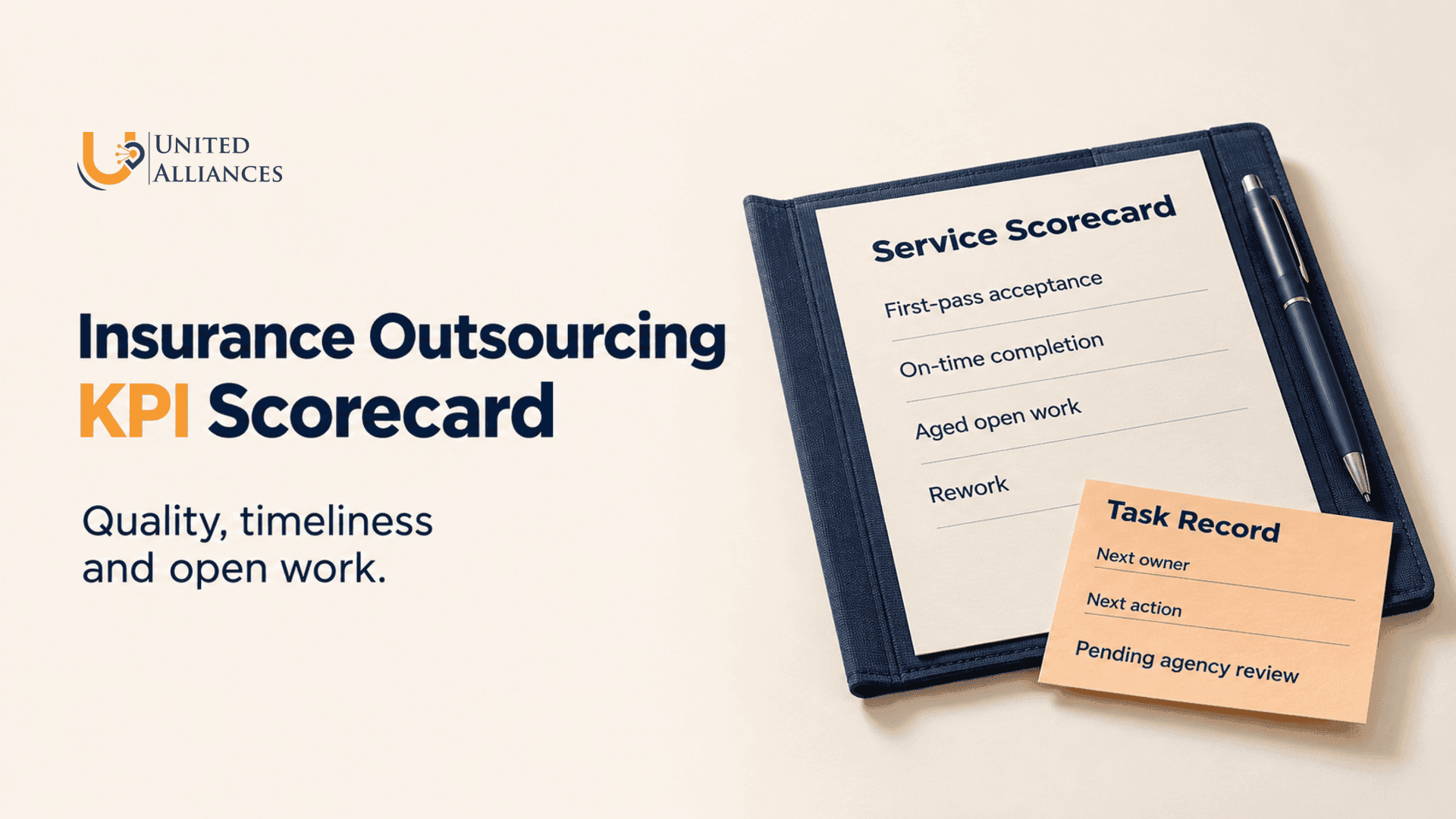

Begin With a Task Record, Not a Dashboard
A useful scorecard starts with one record per request. Give a certificate request, renewal file, endorsement follow-up, and policy download check different workflow codes. Each has a different point of completion. If one client email asks for two unrelated changes, decide whether the agency will create two linked tasks; do not change that rule halfway through a reporting month.
The minimum record contains a task ID, workflow, original received time, time the work became actionable, agreed due time and time zone, current status, next owner, completion time, and link to the supporting AMS activity or document. Add any pause reason with start and end times, review result, correction reason, reopened task link, and the time an exception was detected and escalated. A blank field should mean “not yet recorded,” not “there was no delay.”
| Task-log field group | Record for each request | Purpose in the scorecard |
|---|---|---|
| Identity and scope | Task ID, parent request ID if split, workflow, line of business | Keeps new work and corrections connected without mixing unlike tasks |
| Clock and deadline | Received, ready-to-work, due, completion, time zone, business-hours rule | Rebuilds the total and provider-controlled timelines |
| Current queue | Status, next owner, next action date, pause interval and reason | Shows open work and the person who can move it |
| Review and correction | Checklist version, reviewer, result, defect reason, original task link | Supports first-pass and rework calculations |
| Exception and closure | Detection and escalation times, destination, final AMS or document evidence | Tests handoffs and whether closure is verifiable |
This log need not be a new software product. An agency can use an AMS queue and a carefully controlled report if each field is available, consistently entered, and traceable to the source. A shared spreadsheet with no connection to the policy record will be harder to audit when a status is disputed. The same discipline supports policy servicing handoffs: the next person should be able to see what is pending and why.
Which Insurance Outsourcing KPIs Belong on the Scorecard?
Start with a small dictionary. Each metric below has a specific population and a management question. These are suggested definitions for an agency to adapt, not industry benchmarks or United Alliances performance results.
| Measure | Calculation and eligible population | What it reveals |
|---|---|---|
| First-pass acceptance | Completed tasks accepted without provider-caused correction ÷ eligible completed tasks reviewed | Whether work reaches the agency reviewer ready to use |
| On-time completion | Tasks completed by their agreed due time ÷ all eligible tasks due in the period, including unfinished overdue tasks | Whether the queue delivers by the agreed point |
| Aged open work | Count of open tasks beyond a workflow-specific age or due threshold, grouped by status and next owner | What may be stuck despite a healthy completion rate |
| Rework incidence | Original completed tasks reopened for provider-caused correction ÷ completed tasks in a defined follow-up window | How often apparent completion needs more agency or provider effort |
| Escalation timeliness | Required exceptions sent to the designated owner within the agreed interval ÷ all exceptions requiring escalation | Whether the right person learns of a blocking or material issue in time |
| Verified closure | Closed tasks with the required final document, activity, and reviewer or delivery evidence ÷ sampled closed tasks | Whether “closed” means the agency can reconstruct the outcome |
Use workflow-specific definitions. A standard COI request may finish after an approved document is sent and logged; a renewal preparation task may finish when a complete file and open questions reach the account manager. Neither means the assistant has made a coverage decision. NAIC's producer licensing overview explains the state-regulated activities of selling, soliciting, and negotiating insurance. Keep licensed and carrier-authorized decisions with the appropriate agency personnel, and define the administrative handoff around them.
How Should First-Pass Accuracy Be Calculated?
For a quality-review sample, divide the reviewed tasks accepted without provider-caused rework by all eligible completed tasks reviewed under the same checklist. If 20 completed files are reviewed and 17 are accepted, first-pass acceptance for that sample is 17 ÷ 20, or 85%. It is a sample result; do not label it the accuracy of every file completed that month.
Write down who selects the sample and which defects count. A reviewer who inspects only easy files can inflate the figure. A sample made entirely of complaints can make routine work look worse than it is. ASQ's guidance on quality sampling emphasizes representative selection. An agency may separately review every high-risk item before release, but it should not mix that targeted review with a representative sample and describe the combined percentage as a population estimate.
Also decide how to handle an error found after the initial review. Link it to the original task, record the discovery date and severity, and revise or annotate the original cohort according to a published rule. A late client complaint should not vanish merely because last month's scorecard has been sent. Conversely, a client requesting new work after an accurate completed request is a new task, not provider rework.
Define the Time Clock Before Reporting “On Time”
Every request needs at least two views of time. Total elapsed time begins when the agency receives the request and ends at the agreed final event. Provider-controlled time begins when the provider has the inputs and authority to perform its assigned step; a qualifying documented wait may pause it. The agency should keep both views, because a client still experiences the total wait.
Consider an illustrative certificate request received Wednesday at 9:00 a.m. The holder details are incomplete. The assistant requests the missing information that morning; it arrives Thursday at 11:00 a.m. The file becomes ready to work at 11:30 a.m. and the approved certificate is sent Friday at 2:00 p.m. In calendar time, the client waited 53 hours from receipt to delivery, while the interval from ready-to-work to delivery was 26.5 hours. An agreed business-hours clock would produce another value. Record the times and the rule instead of reporting one unlabeled “turnaround.”
Specify what counts as a legitimate pause: missing client data, documented carrier wait, or an agency decision are possible examples. Require a pause reason, owner, start time, follow-up date, and restart event. A provider cannot pause a clock simply by marking a task “waiting” without identifying the dependency. The original request remains visible in the aged backlog.
For an on-time completion rate, choose the cohort of tasks due in the reporting period. Count those finished by their agreed due point in the numerator and all eligible tasks due in the denominator, including tasks still open after their due time. Reporting only on completed tasks hides overdue work. A second provider-controlled result can be shown if the contract permits pauses; show it beside the total client-elapsed result, with exclusions and counts displayed.
Keep the Backlog and Reopened Work in View
A monthly completion percentage is a flow measure. Open work is a snapshot. Report open tasks by workflow and reason: ready for provider, waiting for client, waiting for carrier, pending agency review, in rework, or another defined state. For each aging band, show the count, oldest item, next owner, and next action date. An open renewal file near expiration deserves attention even when the team has closed hundreds of routine document tasks.
Rework needs a link to the original request. Suppose an endorsement support task is closed after submission, then reopened because the assistant omitted a carrier attachment. That is provider-caused rework under the agreed definition. If the carrier later asks a new underwriting question, it may be a related follow-up, not a defect. Record who made the classification and allow an agency reviewer to challenge it. Otherwise, a team can improve its figures by closing and reopening work under new IDs.
Count both the incidence and the work it creates. An occasional minor correction and a repeated client-facing error should not be treated as interchangeable. Review defect categories and severity in the underlying log. The KPI points to a question; the task record explains the answer.
What Does a Worked Monthly Scorecard Look Like?
Imagine a hypothetical October COI queue with 40 eligible requests due during the month. Thirty-one were finished by their agreed due time, four finished late, and five were still open after their due time. The on-time completion rate is 31 ÷ 40 = 77.5%. The five open requests stay in the denominator and appear again in the backlog by age and owner.
Of the completed files, the agency reviewed a representative sample of 20. Seventeen were accepted without provider-caused correction, so the sample's first-pass acceptance is 17 ÷ 20 = 85%. Six exceptions required escalation and five reached the designated person within the agreed interval, giving 5 ÷ 6 = 83.3% escalation timeliness. Those three percentages use different denominators. They should never be combined into a single “overall accuracy” score.
The next review should ask what happened to the five overdue open requests, which defects drove the three returned files, and whether the late escalation delayed a client response. These figures are illustrations of the arithmetic, not targets, benchmarks, or actual results for United Alliances or any provider.
Turn the Numbers Into an Agency Decision
Review aging and urgent exceptions during the week; do not wait for a monthly deck when a renewal or time-sensitive request is at risk. In the monthly review, reconcile totals to the task register, inspect a few source records, and note any change in work mix, staffing, or definition. Compare a certificate queue with its own prior months, and a commercial renewal queue with its own; a combined average can conceal a problem in the smaller, more complex group.
Give every recurring miss an owner and a response. A late task might point to a missing intake field, carrier delay, provider capacity, or an agency approval bottleneck. A rework trend might require a better template or a changed reviewer handoff. Record the change and check the next cohort. If the action is “work faster” without identifying the cause, the scorecard has not helped manage the service.
The agency may also want to know whether outsourcing has reduced internal effort. Sample the account manager's time spent clarifying and correcting eligible tasks before and after a stable handoff. That is harder to measure than task volume, so show the method and sample size; do not infer time saved from the number of requests the provider closed. For a wider discussion of what to inspect before contracting, see the insurance back-office partner selection guide.
What Reporting Can United Alliances Discuss With an Agency?
United Alliances' insurance back-office outsourcing service describes task intake, AMS or carrier portal updates, a quality check, and completion logging. Its published service options describe daily task logs and weekly summaries for a full-time dedicated assistant, and real-time task tracking and weekly SLA scorecards for a dedicated team. The insurance virtual assistant service describes task visibility across agency workflows. These are the company's descriptions of its offerings, not evidence of a particular agency's measured outcome.
Ask United Alliances for an anonymized sample report for the option proposed to your agency. Confirm which fields are available from your AMS and the working queue, who records pauses and corrections, whether the agency can audit a task back to its source, and how an exception is assigned. Agree on a short KPI dictionary and review cadence for the actual workflow. The same definitions should be used to evaluate any other provider's report.
Measure the Work the Agency Needs Finished
Start with one queue and a few weeks of task records. Define the due point, review outcome, wait reasons, and reopen rule with the people doing the work. Use the first scorecard to assign an instruction, approval, or capacity change. To test this with renewals, certificates, or policy servicing, discuss the workflow and reporting fields with United Alliances using a sample task and your current AMS procedure.