
What Does “Accurate” Mean in an Agency Management System?
An AMS record can be complete and still be wrong. A policy number may be filled in but belong to an expired term. A document may be saved but attached to the wrong account. An activity may say “done” even though the carrier has not confirmed the requested change.
For each workflow, define accuracy in four parts: the right value, the right record, the right time, and a traceable source. Completeness is a separate question: are all required fields, documents, and activity notes present? Timeliness asks whether the record was updated at the agreed point in the workflow. A single “clean data” label hides these different failure modes.
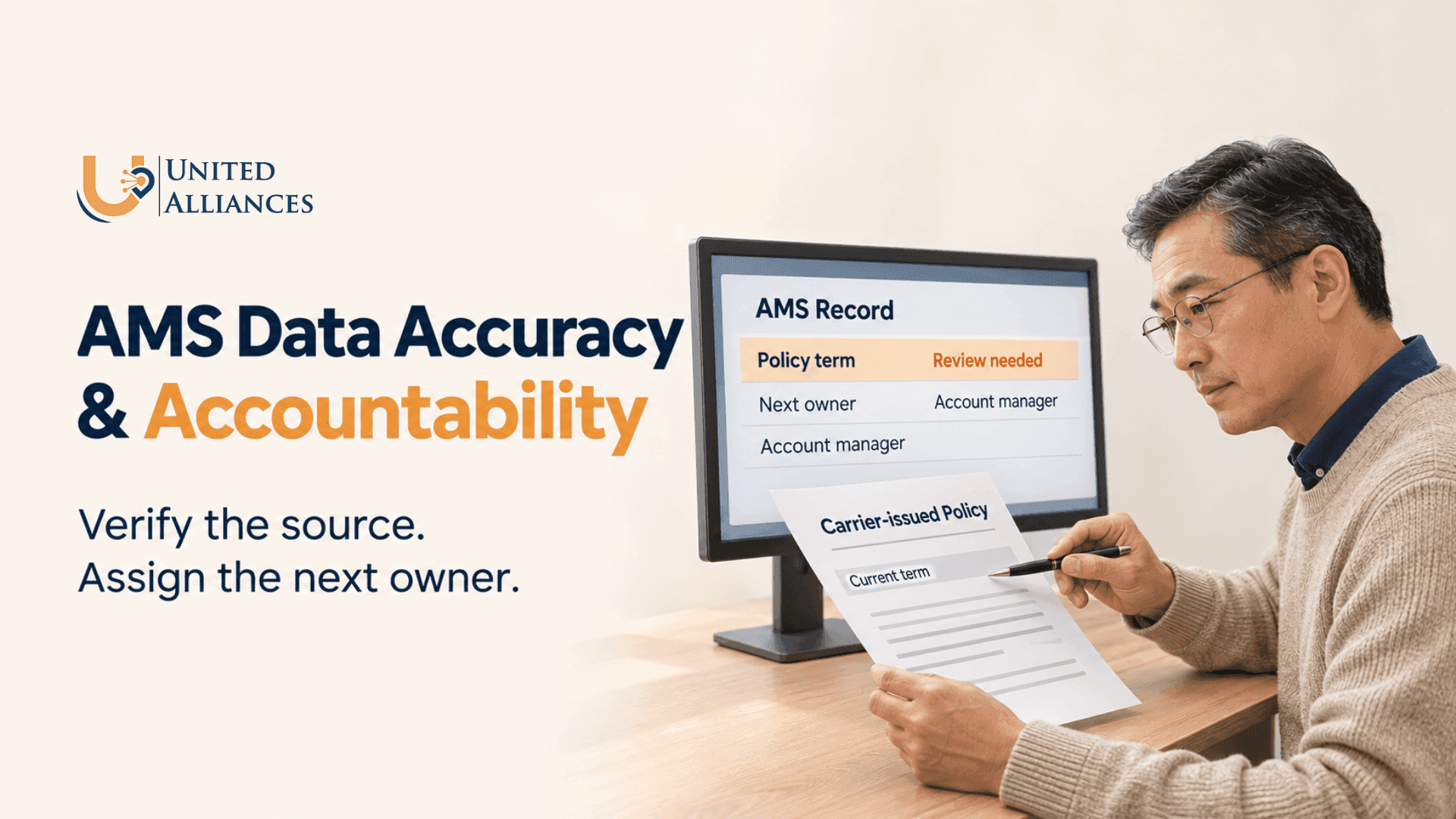
The AMS is the place the team works, but it is not always the authority for an insurance fact. For an issued policy term or endorsement, compare the record with the current carrier-issued document and the agency's approved process. For a pending change, a client's request tells you what was asked for; it does not establish what coverage or effective date the carrier issued. If the sources conflict, record the conflict and send it to an authorized agency reviewer. Do not silently choose whichever value is easiest to enter.
| Item to verify | Evidence to compare | Common mistake to catch |
|---|---|---|
| Policy number, term, and status | Current carrier-issued policy, renewal, endorsement, or documented carrier response | Prior-term data copied into a current record; submitted request marked issued |
| Named insured, location, vehicle, or driver | Current policy documents and the approved change history | Requested change entered as an effective change before confirmation |
| Contact and correspondence details | Agency-approved client information and recent verified communication | Stale address or email treated as current without checking |
| Documents and activities | Original request, carrier output, approval, and the agency's indexing rule | Correct file attached to the wrong policy; “complete” note without outcome |
This is a field-specific source guide, not a universal hierarchy. Agencies should document which version and event control a field in each workflow. A producer or account manager may need to resolve a disputed policy fact; an AMS administrator may control how the approved correction is made in the system.
How Should an Agency Audit AMS Data Accuracy?
Pick one workflow before running a broad cleanup. Renewal records, policy downloads, endorsement follow-ups, or certificate activities each have a different set of required fields and completion evidence. Write the checklist first. Include the field definition, applicable source, acceptable blank or “not applicable” conditions, reviewer, and what counts as a defect.
Then draw a sample from a defined population, such as all commercial-auto renewals processed last month. Include different handlers, carriers, and request types where possible. A few files known to have problems can help investigate causes, but they should be reported separately from a representative quality sample. ASQ's explanation of quality sampling notes why representative selection matters when using a sample to infer something about the broader population.
For each selected record, inspect the actual source and the AMS entry. Classify what you find: missing, wrong, stale, misfiled, duplicate candidate, undocumented status, or unclear source. “Unclear” is useful. It prevents an auditor from calling a field correct without enough evidence and gives the agency a specific question to resolve.
A small audit log the team can use
The audit log should link back to the record rather than becoming a second, disconnected policy database. Use the AMS activity or a controlled review register, according to the agency's access and retention rules. A workable row contains the following fields:
| Field group | Capture | Reason |
|---|---|---|
| Record identity | Account and policy IDs, line of business, sampled workflow, reviewer, review date | Reopens the exact record and establishes the sample |
| Discrepancy | Field name, observed AMS value, expected value or unresolved question, defect type | Shows what the reviewer actually found |
| Evidence | Source document or activity link, version or issue date, applicable standard | Lets another person verify the conclusion |
| Resolution | Correction owner, decision owner if different, status, due or follow-up date | Keeps a finding from becoming an orphaned note |
| Closure | Approved action, change date, reviewer confirmation, retained evidence | Distinguishes an identified error from a verified fix |
Illustrative entry: Record A-1042 / policy P-33870 shows a prior term's expiration date in the AMS. The current carrier-issued renewal declarations, linked in the audit record, show the later date. The reviewer marks the field “stale term,” assigns the account manager to confirm that this is the correct policy record, and leaves the finding open. After approval, the assigned administrator updates the field, links the source, and a second reviewer verifies it. These IDs and events are fictional; they illustrate the log, not a United Alliances client result.
Do not put sensitive policy details into an open spreadsheet or email merely to create an audit trail. Point to the controlled source and follow the agency's permissions, documentation, and retention rules.
How Do You Handle Duplicate or Mismatched Policy Records?
Treat a possible duplicate as a review item, not an invitation to merge records in bulk. Two accounts with similar names may represent separate legal entities, locations, households, or parent and subsidiary relationships. The same policy number may also appear across terms or in related workflows, depending on the system's structure.
Compare identifiers, carrier, line, term, named insured, account relationships, linked documents, and open activities. Identify which record the agency uses as the active operational record. Have an authorized owner approve any merge, archive, or reassignment after checking whether it could break reporting, document history, open tasks, or downstream integrations. Record the disposition as confirmed duplicate, related but separate, or unresolved. A duplicate candidate is not the same as a confirmed duplicate.
For a mismatch, distinguish data entry from coverage or policy interpretation. An assistant can flag a discrepancy between the AMS and the issued document and prepare a correction under the agency's procedure. If the issued documents conflict, an effective date is disputed, or a client asks what coverage applies, the agency's authorized person must make the determination. The NAIC's producer licensing overview describes the state-regulated activities of selling, soliciting, and negotiating insurance; the agency should define its own task boundaries under the applicable state rules and carrier authority.
Make Activities and Documents Explain the Status
Data quality is also a handoff problem. An “updated” note is thin evidence if it does not say what changed, which policy and term it concerns, what is still pending, and who owns the next action. The agency can set a short activity standard: request received; required information checked; source or carrier response linked; action taken; open question and owner; next follow-up date; final review and closure evidence. Some events need only a few lines, but the next person should not have to reconstruct the file from an inbox.
Apply one document naming and indexing convention that fits the agency's AMS. It should distinguish a request from an issued document, the current term from an old term, and a reviewed final version from a draft. The correct attachment under the wrong insured or policy can be more harmful than a missing attachment because it appears available. Check the link to the account and policy during review.
For example, a vehicle-change request may be logged on Monday, submitted to a carrier on Tuesday, and confirmed in an issued endorsement later. The AMS should reflect those separate events. Closing the activity at submission without a follow-up owner makes the record look finished too soon. The same discipline applies to policy servicing handoffs across the agency.
Who Owns Corrections and Accountability?
Give the person who finds a defect a way to raise it without requiring that person to decide every policy fact. The work can pass through several hands, but the audit log should always show one next owner and one next action date.
| Role | Typical responsibility | Stop or review point |
|---|---|---|
| Reviewer or administrative assistant | Compare fields with the approved source, log evidence, make permitted routine edits | Hold disputed policy facts, nonstandard changes, and unclear duplicates |
| Account manager or authorized producer | Resolve client or policy questions, approve the interpretation and client-facing action | Retain decisions requiring agency authority or a license |
| AMS administrator | Apply approved record merges, permissions, codes, or system-wide fixes | Check effects on linked activities, documents, and reporting |
| Quality reviewer or operations lead | Confirm correction evidence, watch aging and repeat defects, revise the SOP | Escalate unresolved patterns and control failures |
These are example roles; one person may hold more than one in a small agency. What matters is separating identification, decision, system change, and verification when the risk warrants it. A clerical typo in a verified contact field may need a simple approved correction; a disputed limit or effective date should not be handled by the same shortcut.
Which Measures Show That the Cleanup Worked?
Start with a few measures whose denominators are visible. Field accuracy in the reviewed sample is correct eligible field instances divided by all eligible inspected field instances. Suppose an illustrative audit inspects 50 required field instances: 43 match the defined source, four are missing, and three are wrong. The sample result is 43 ÷ 50 = 86%. This is a result for those inspected fields, not a claim about all agency records or an industry benchmark. Document genuinely inapplicable fields rather than quietly counting them as correct.
Also track the number of records with at least one material defect, open correction findings by age and owner, confirmed duplicates, and repeat defects by workflow and cause. A policy term and a minor naming inconsistency should not be treated as equal risk; report severity alongside the count. Review high-risk findings promptly and compare later samples of the same workflow under the same checklist. If the sampling method or field standard changes, annotate the trend.
Where United Alliances Fits in an AMS Cleanup
United Alliances' insurance virtual assistant service describes support for AMS updates alongside renewals, endorsements, COIs, and other administrative insurance workflows. Its back-office outsourcing service describes intake, quality checks, and completion logging within agency work. Those public descriptions identify possible support areas; the exact assigned tasks, system access, and review rights need to be agreed for an agency's own configuration.
A practical discussion with United Alliances would start with one defined queue and its data standard. Share a sanitized sample of the agency's field checklist, ask who will log mismatches and follow-ups, decide which edits can be made under an approved procedure, and identify the agency owner for disputed or policy-sensitive facts. Confirm how a corrected AMS entry will be checked against the source. The guide to choosing an insurance virtual assistant service offers broader questions for comparing a proposed support model. If the AMS queue is the immediate problem, contact United Alliances to discuss that workflow specifically.